


A Reiki master wrote a UK number two, and it’s both AI and human
The songs you know
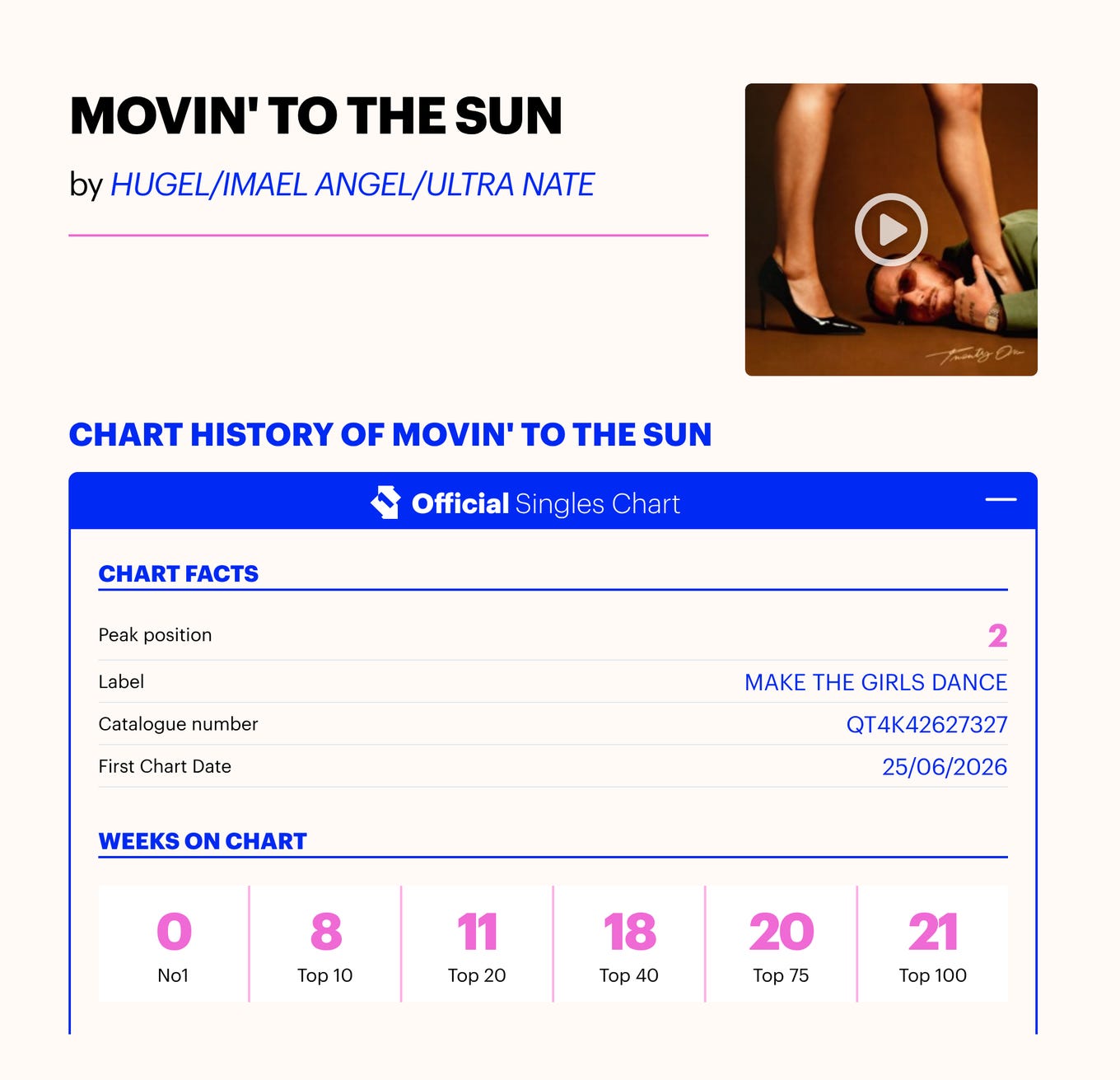
If you’ve opened TikTok or Instagram this year, you’ve heard Movin’ To The Sun. It plays under cats in dresses and dads dancing badly in parked cars. On the Official Charts it reached number two in the UK, credited to HUGEL, Imael Angel and Ultra Naté. It first charted on 25 June 2026 and stayed on the singles chart for months.
Most people dancing to it never wondered where it came from. Fair enough. The ones who did kept typing the same thing into the comments, some version of “is this AI or real?”
We went looking for the answer, and we think the question has stopped working. This song is both, at every layer. Once we’d traced how it was put together, we started seeing the same pattern well beyond music.
Who wrote it
Imael Angel is the stage name of Bernadett Gango, a Hungarian-born Reiki master (Reiki is a form of energy healing) living in England. Bands and studios were never part of her life.
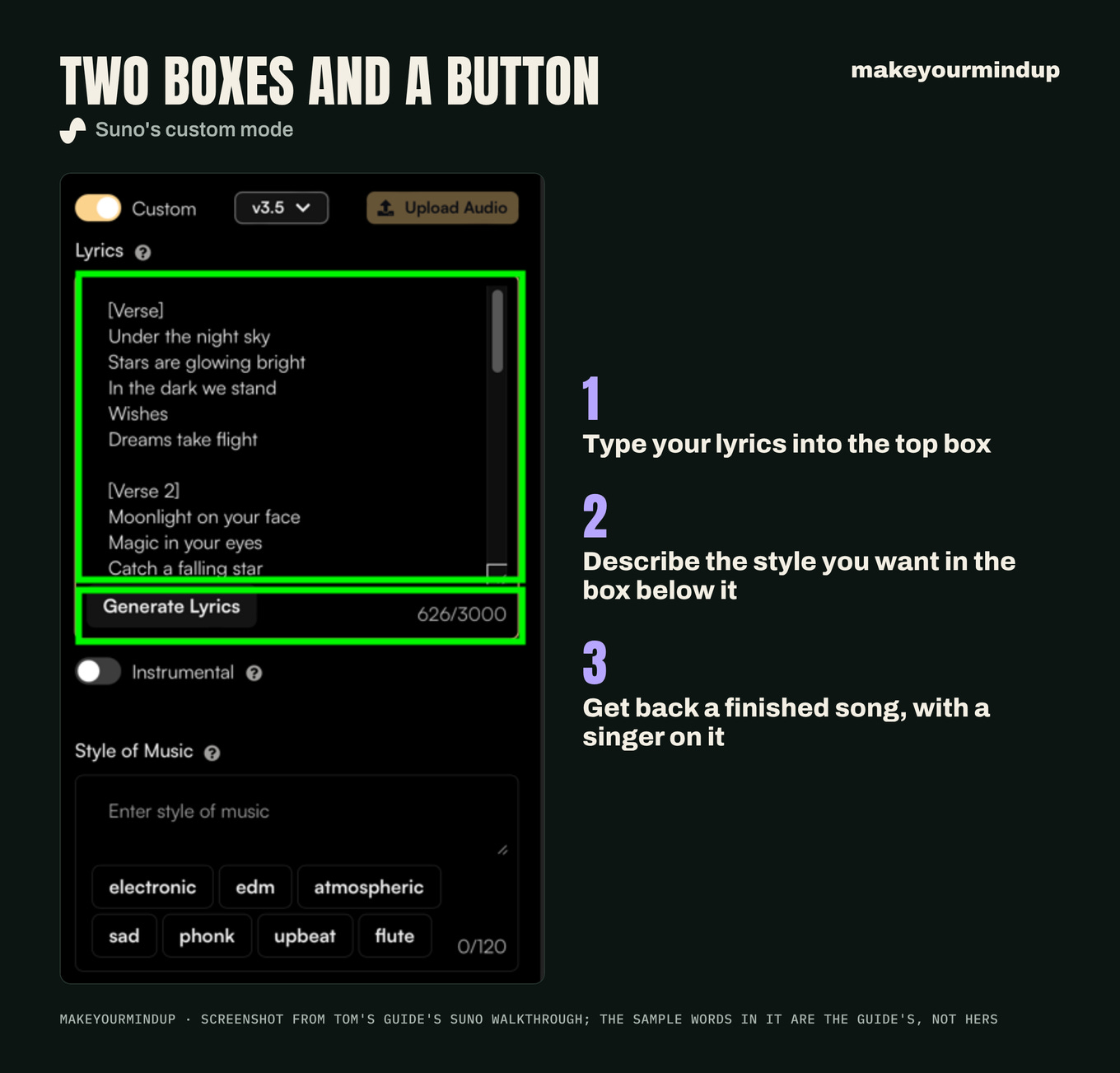
She had lyrics and an AI music app. Suno’s custom mode has a box for your lyrics and a box for the style of music you want, and it turns them into a song with vocals. (If you don’t like the second verse, you don’t rewrite it. You generate again.) Her early catalogue was made with Suno and Udio, another AI music app, so the first voices on her songs were generated by AI. We couldn’t confirm which of the two made this song’s first version.
That’s the part people struggle with. It’s also the real story: without studio time or years of learning the software, someone with her background had almost no route to a chart hit. AI tools moved that barrier, and a finished demo from an app got her through it.
A demo on its own goes nowhere. Strangers did the next bit.
What we saw, scrolling the clips and threads ourselves, was people hearing it behind someone else’s video and going hunting. In the comments and the Reddit threads we read, a lot of people were simply trying to find out what the song was (after hearing it under a cat video, say, or a father-daughter dance).
As we read it, short videos came first and the charts followed, after strangers had already decided they liked it.
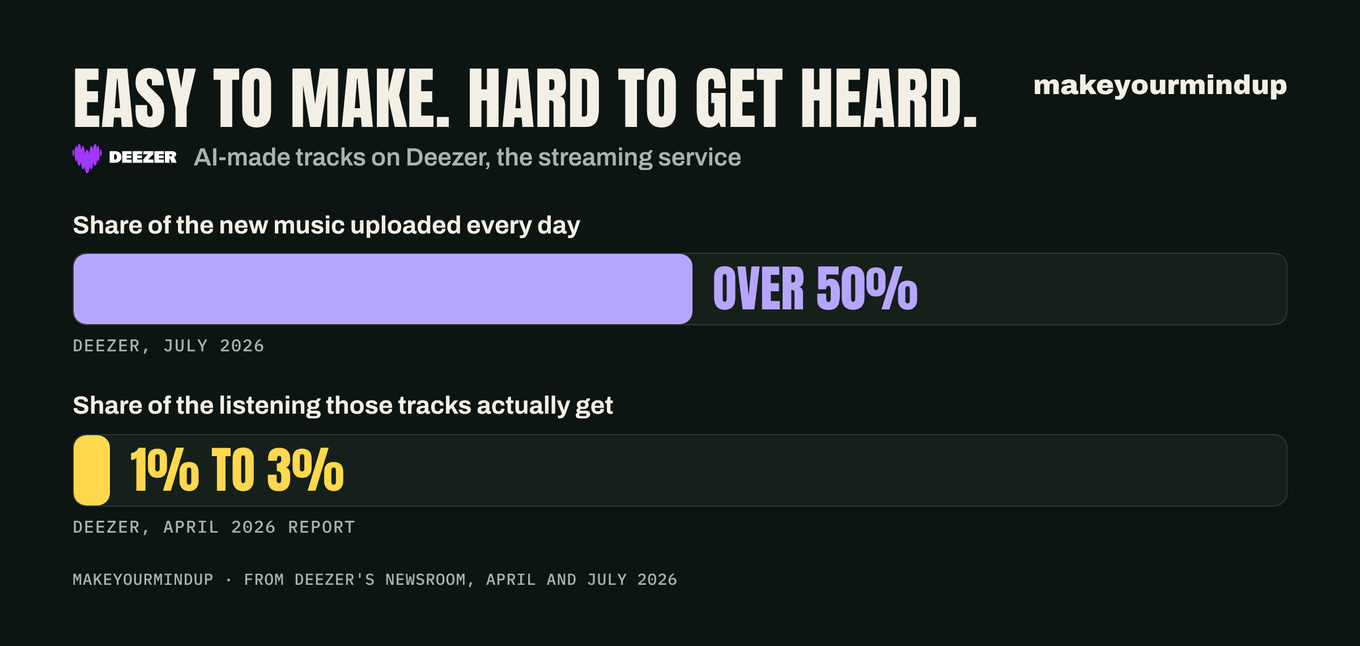
That order matters more than it used to, because music has never been more crowded. Deezer, the streaming service, said in July 2026 that AI-made tracks had passed 50% of the new music uploaded to it every day. In an earlier report, in April, it put the share of listening that AI-made tracks get at between 1% and 3%. Making a song isn’t the hard part any more. Getting a stranger to go looking for it is. This one got found.
The people who finished it
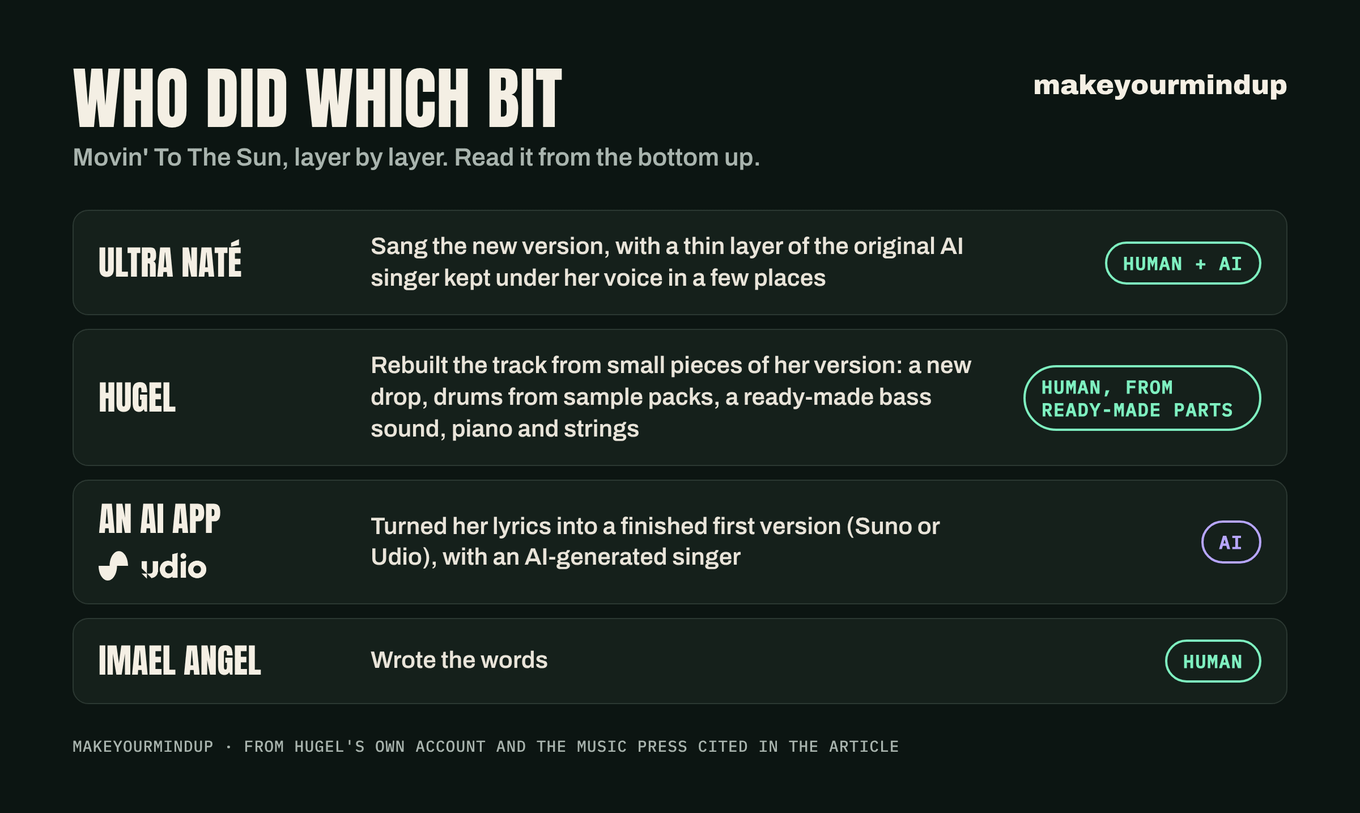
HUGEL, a DJ and producer, took small pieces of her AI version and rebuilt the track around them, with a new drop (the moment the big beat kicks in). His own list of what went in, as the dance music site We Rave You reported it, starts with drums from sample packs (ready-made recordings producers buy, some from a shop called Splice) and a bass preset, a ready-made sound, from the music software Serum. His list also includes an extra piano and a string layer for tension.
Even that “human” version isn’t as human as it sounds. Drums from sample packs are recordings anyone can buy and reuse, and a bass preset is a sound someone else designed. We’d call that normal for dance music, and it was normal long before AI turned up.
Next HUGEL brought in Ultra Naté, an American singer of house, the club dance music, best known for her 90s hit “Free”. She sang the new version. Under her voice, in a few places, he kept a thin layer of the original AI singer. We love this detail: the hit you’ve been dancing to has a robot humming along under a dance legend.
In HUGEL’s own words, “The AI was just used to do the layer of the vocal.” By his account, then, the record isn’t fully AI, and it isn’t fully human either.
Both at once
The either-or question falls apart in public at the Grammys.
The Grammys judge songwriting in some categories and performance in others. First, in September, music press reports said the Recording Academy, which runs the Grammys, had taken the track out of the running altogether over its AI involvement. HUGEL challenged that, pointing to his project files, the working files that show how a track was built.
Then, on 16 October, the newspaper The Australian reported a narrower ruling. The song can’t compete in the songwriting categories, because it uses material from Imael Angel’s AI-generated original. HUGEL and Ultra Naté could still be eligible in the performance categories.
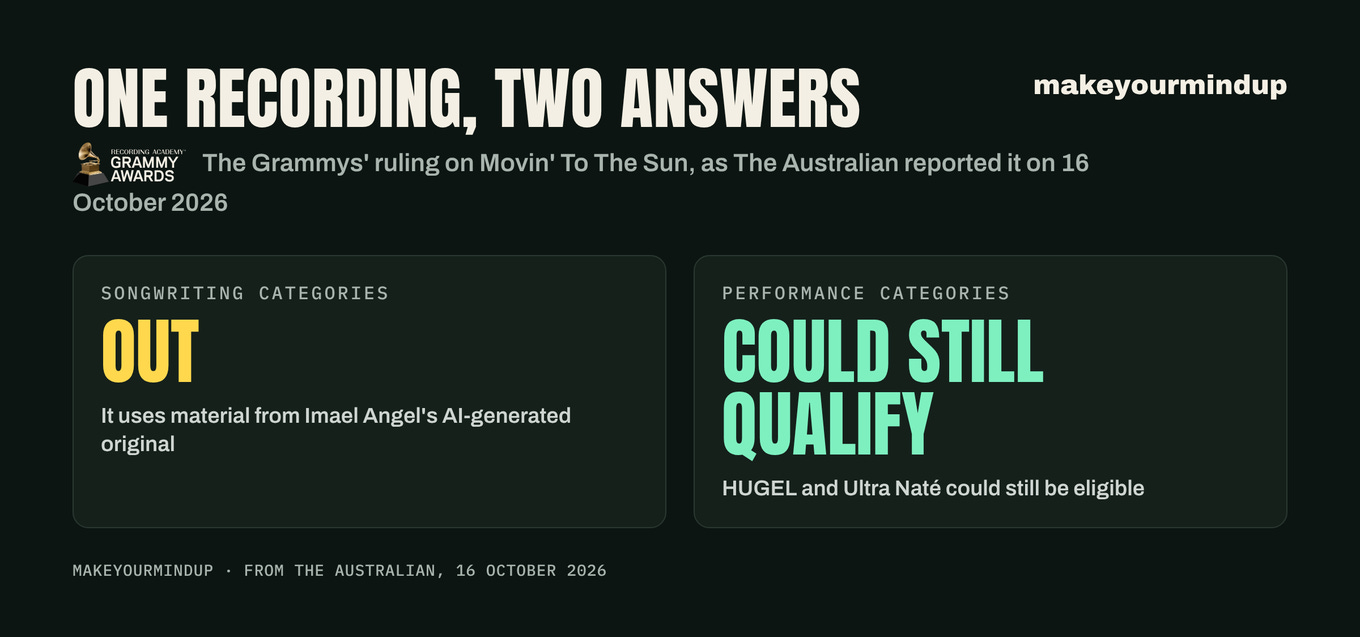
The same recording is out for the writing and could still be in for the singing. The organisation whose whole job is judging music couldn’t file this song under one word, because no single word fits it.
Count the layers and you see why. At the bottom are her words. On top of them sits an AI app’s first version, voice and all. Then comes a producer’s rebuild, mostly from samples and presets. On top is a legend’s vocal, with a trace of the AI voice still underneath.
Back on the dance floor
We’d stop asking whether it’s AI music or human music. The song you can’t stop dancing to is already both, and that’s how music gets made now.
That shift is worth carrying out of this story, because the pattern isn’t confined to music. The advert you scrolled past this morning and the deck your team sent last night are increasingly made the same way. A person has the idea, a machine does a first draft, and people rebuild and finish it, with some of the machine’s work still in there. “Did AI make this?” tells you very little about any of them. It’s a yes-or-no question about something that isn’t yes or no any more.
Who did which bit tells you far more: how much to trust a thing, and who to call when it goes wrong. And when making things gets cheap, being found becomes the scarce part, in your market as much as in music.
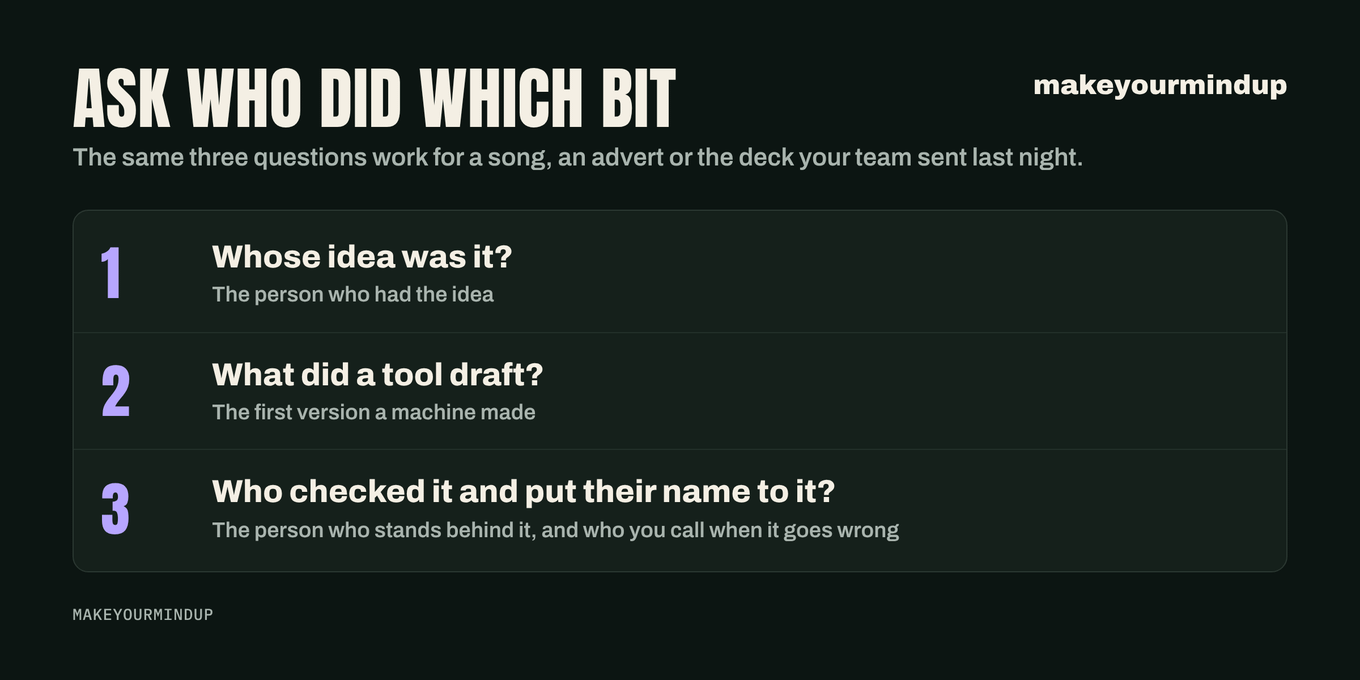
If you manage people, that changes what you ask when work lands on your desk. Ask whose idea it was, what a tool drafted and who checked it and put their name to it. Then make those three answers part of how your team signs work off, for example as a line on every brief or sign-off form, so the name on a piece of work belongs to the person who stands behind it.
This story also shows who gets in. A Reiki master with no studio got a UK number two because AI got her as far as a finished demo and people carried it the rest of the way. We think that door is opening in every field, yours included, and the people coming through it won’t look like the ones who came before.
Next time a song gets stuck in your head, or work lands on your desk that’s better than you expected, ask who did which bit. Almost every time, the answer will be both.
OUR PREDICTION
HUGEL’s challenge won’t change the split. By 10 February 2027, Movin’ To The Sun will still be out of the Grammys’ songwriting categories, even if it gets nominated for performance. How sure we are: 85%.
SOURCES
Deezer: AI-generated tracks represent 44% of new uploaded music (April 2026)
27 The Journal: Movin’ To The Sun, how human is human enough?
Checked on 11 November 2026 against the sources below.


