


Disney would only take on a dying AI company’s team through the bankruptcy court, so it could hire the team and leave the lawsuits behind.
That company is Character.AI, the app where millions of people chat with made-up characters. It filed for bankruptcy in Delaware on 12 October. Google and Disney have now paid for pieces of it, two years apart, for two very different reasons. And the people who used it are left holding whatever remains.
This piece follows why Google and Disney both paid for Character.AI, and what that means for any business that runs on someone else’s AI.
GOOGLE PAID FOR THE BRAINS
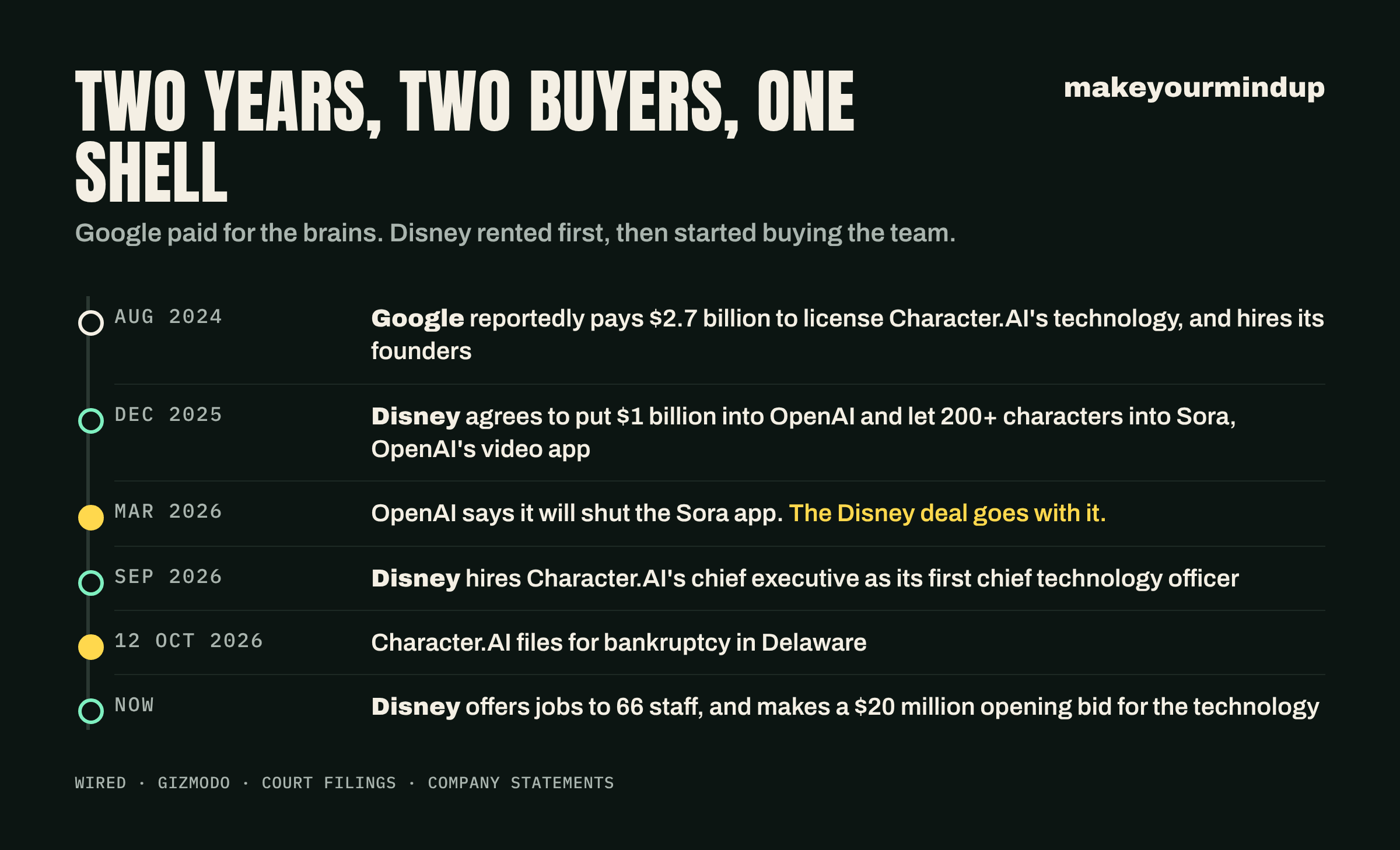
In August 2024, Google reportedly paid $2.7 billion to license Character.AI’s technology. A spokesperson told Wired that the licence covered the technology as it stood at the time, and that Google also hired the founders and other members of their research team.
The “vast majority” of the staff stayed at Character.AI, the same spokesperson said. The app kept running too, as if nothing much had happened.
Our read on Google is simple: it wanted the people who built Character.AI, and a licence to use what they had built. So it paid for both, and left the company standing.
Keep that date in your head. August 2024 is when the founders went to Google. The bankruptcy came in October 2026. The founders leaving was the first warning sign in this story, and it was easy to miss.
DISNEY TRIED RENTING FIRST
Disney’s reason starts somewhere else entirely.
In December 2025, Disney agreed to put $1 billion into OpenAI and to let more than 200 of its characters appear in Sora, OpenAI’s video app. Marvel, Pixar and Star Wars would all be in there. A big bet, with one catch: every one of those characters would live on someone else’s app.
Then in March 2026, OpenAI said it would shut its Sora app. The Disney deal went with it, and reports say no money had changed hands. Disney said it respected the decision, which is the corporate way of saying it had just been left standing in the rain.
We think the rest of the story turns on this moment. Disney had licensed its characters to someone else’s app, and that app closed.
NOW DISNEY IS BUYING THE TEAM
So Disney changed its approach. In September it hired Character.AI’s chief executive as its first chief technology officer.
As for why Disney chose Character.AI out of every AI company it could have picked, look at what each side owns. Disney owns Marvel, Pixar and Star Wars, and Character.AI’s app lets millions of people chat with made-up characters. After Sora, Disney seems to have decided it would rather own the team that does this than rent space on someone else’s app. That’s our inference from the timing and the filings; Disney hasn’t said it in those words.
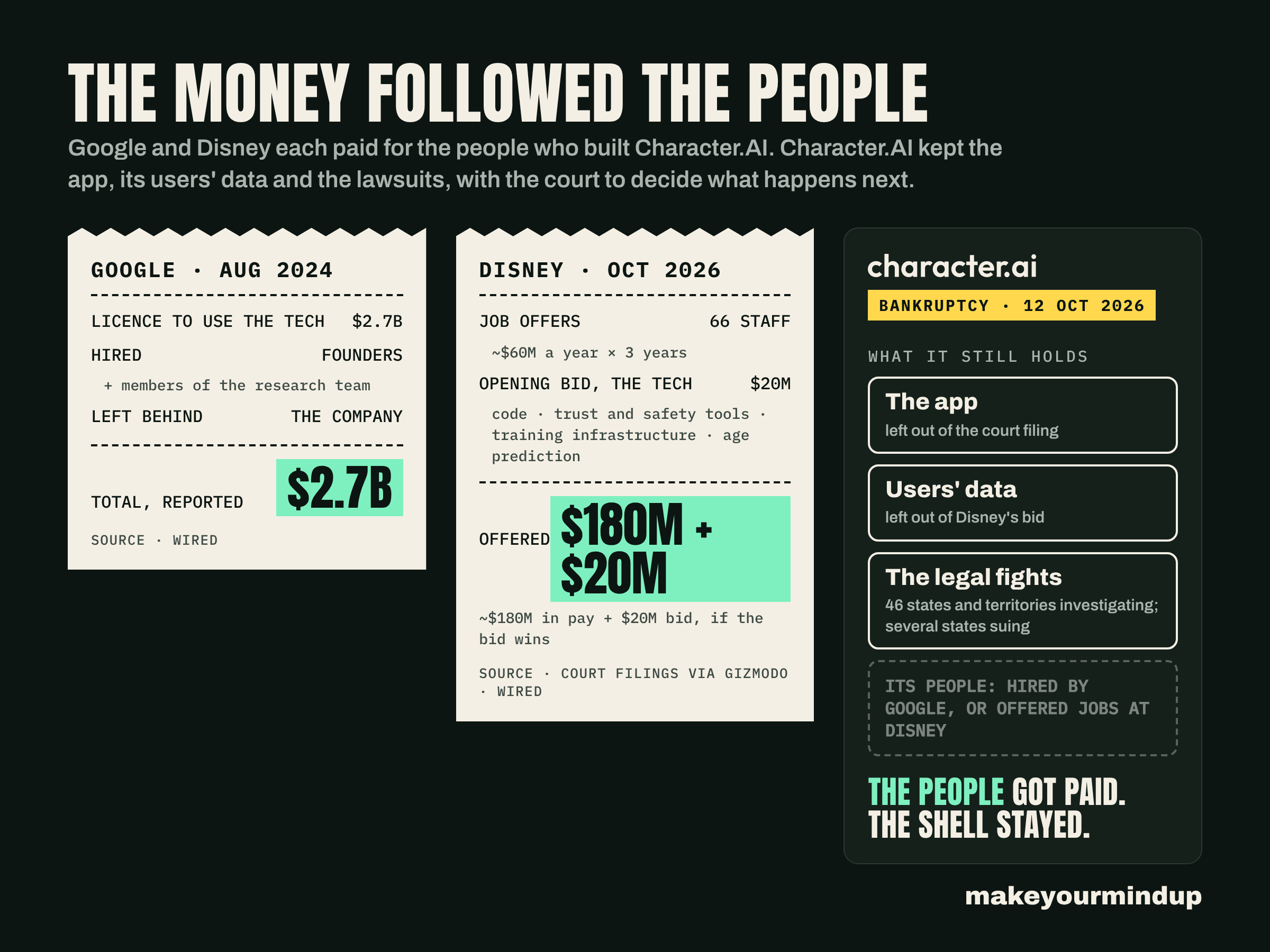
Then came the court papers. Disney has offered jobs to 66 of Character.AI’s staff, most of the workforce. Their pay comes to about $60 million a year for three years, around $180 million in all, according to the filings reported by Gizmodo. On top of that, Disney has made the opening $20 million bid for rights to Character.AI’s technology, a bid other buyers can still beat. Wired reports that the list of what Disney is bidding for covers its code, its trust and safety tools, its training infrastructure and its age-prediction technology.
Here’s the part we keep coming back to. The filings say Disney required the deal to go through the bankruptcy court, because of Character.AI’s “diminishing cash reserve and significant litigation and regulatory risks”. Wired reports that a draft court order would leave Character.AI responsible for “any liability or other obligation” it might have.
If the court approves, Disney gets the people and much of the code. Character.AI keeps the legal fights.
WHO IS LEFT WITH THE SHELL
Two groups stay behind.
First, the people who used the app. According to Wired, the list of what Disney is bidding for leaves out users’ data and Character.AI’s website, and the court filing leaves out its consumer-facing apps. What happens to the app now is up to the court. Anyone who spent two years chatting to a made-up character on there will want to know where those chats end up.
Second, everyone with a claim against it. Families sued Character.AI, saying its chatbots harmed children; those families agreed to settle, and a referee approved each settlement on 11 October, the day before the bankruptcy. When it filed, 46 states and territories were investigating it, and several states have sued. Wired reports the deal is built so that whatever is left of Character.AI keeps responsibility for those legal battles, some of them still going.
So the money followed the people. Google reportedly paid $2.7 billion to use the tech and hire the founders. Disney is offering about $180 million in pay to most of the rest of the staff, plus a $20 million bid for the technology. Everyone else gets the empty box.
If your business runs on someone else’s AI, this is the part worth sitting with. You can’t stop your supplier being bought or shut down. You can spot the signs early, and in this story they showed up years before the end.
OUR PREDICTION
Beyond Disney, our read is that the companies with the most to lose are deciding that renting their AI is too risky.
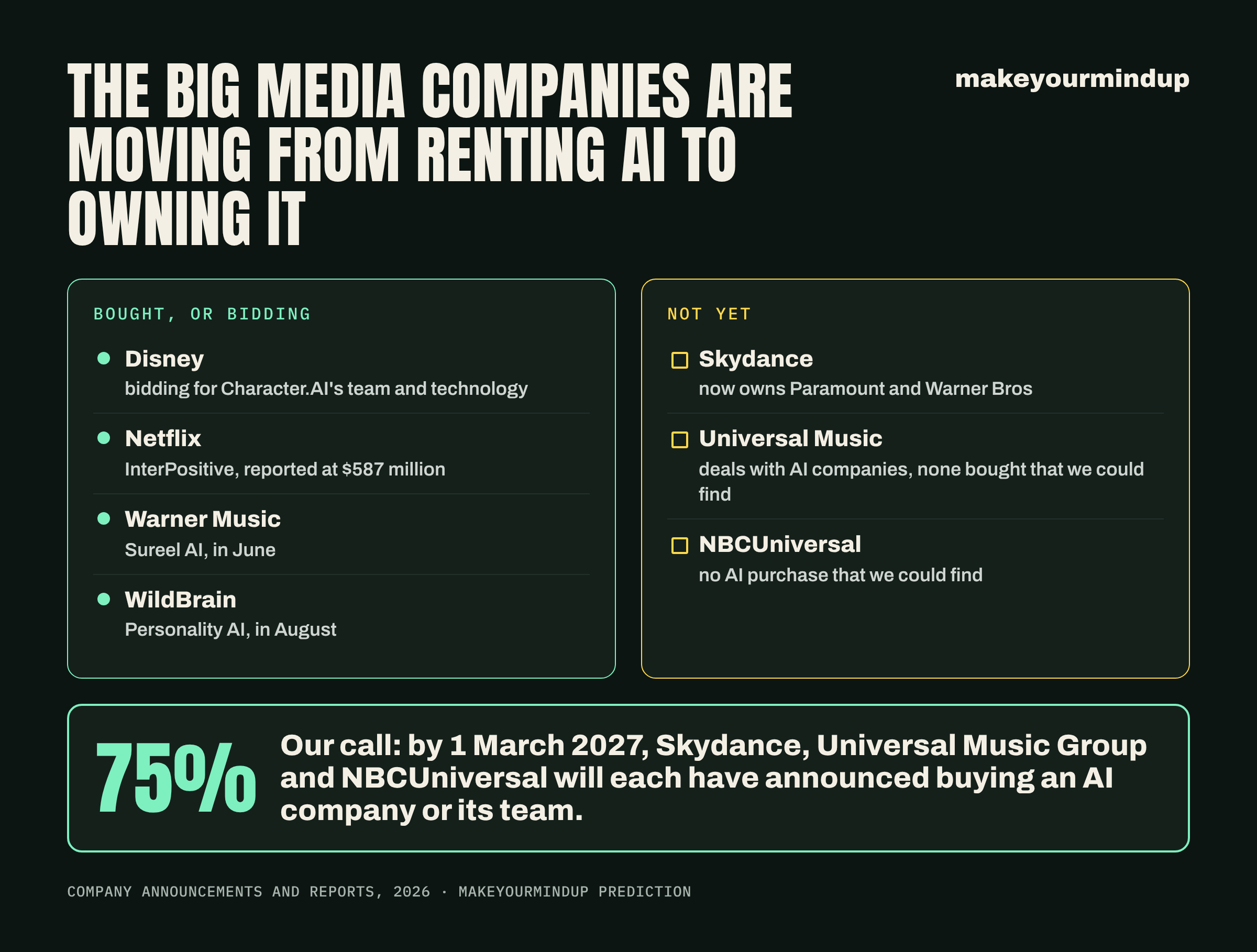
Disney isn’t alone. This year Netflix bought InterPositive, an AI filmmaking start-up, in a deal reported at $587 million. Warner Music bought Sureel AI in June. WildBrain, the company behind the Teletubbies, bought Personality AI in August.
Put those together and a pattern shows. The big media companies are moving from renting AI to owning it.
Three of the biggest haven’t made that move yet. Skydance, which now owns Paramount and Warner Bros after its merger closed on 6 October, calls the combined company “tech-forward”. Universal Music has struck agreements with AI companies, including Nvidia, but we could find none it has bought, while its rival Warner Music has. NBCUniversal has made no AI purchase that we could find.
Each of them now has a rival that has bought, and Disney has just shown everyone what renting can cost. That’s why we think they move next.
Our prediction. By 1 March 2027, Skydance, Universal Music Group and Comcast’s NBCUniversal will each have announced buying an AI company or its team. How sure we are: 75%.
It isn’t higher because all three have to move inside about four months, and any one of them could decide that renting is fine for now.
If the giants with the deepest pockets won’t leave their AI in someone else’s hands, it’s worth knowing whose hands yours is in.
3 things you can do tomorrow
Write down the AI tools your business would struggle without, and who makes each one. Most leaders know the tools. Fewer know whether the maker is a giant, a start-up or a giant’s side project.
For the one you lean on most, answer four questions about its maker. Are its founders still there? Is your tool its main product or a side bet? Is it short of cash? Is it collecting lawsuits? Google hired Character.AI’s founders in August 2024, two years before the bankruptcy; OpenAI said it would shut its Sora video app; and the court filing warned about cash and litigation.
If two of those answers worry you, pick your plan B now. Choose the tool you would move to, and try it on one real task this month, while you still have time to switch calmly.


