

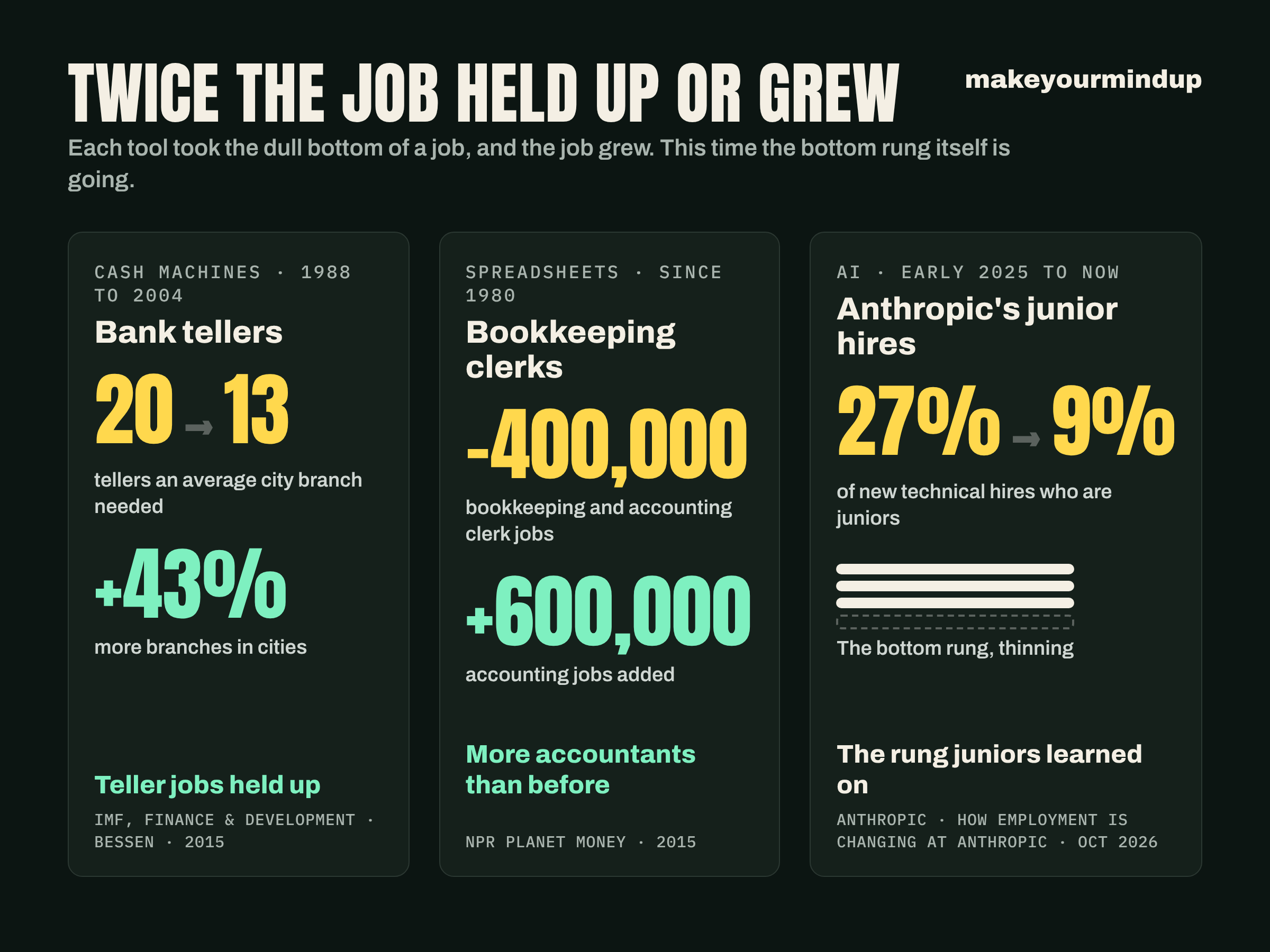
Anthropic, the company behind Claude, has just published a study of its own staff, and one line stopped us. Since early 2025, the share of its new technical hires who are juniors has fallen from 27% to 9%.
That’s roughly one new technical hire in four becoming fewer than one in ten. And it comes from the company that knows better than anyone what its own tools can do.
So every business now has to work out who trains the seniors it’ll need in 2030, if AI takes the work juniors used to learn on.
THE BOTTOM RUNG IS GOING
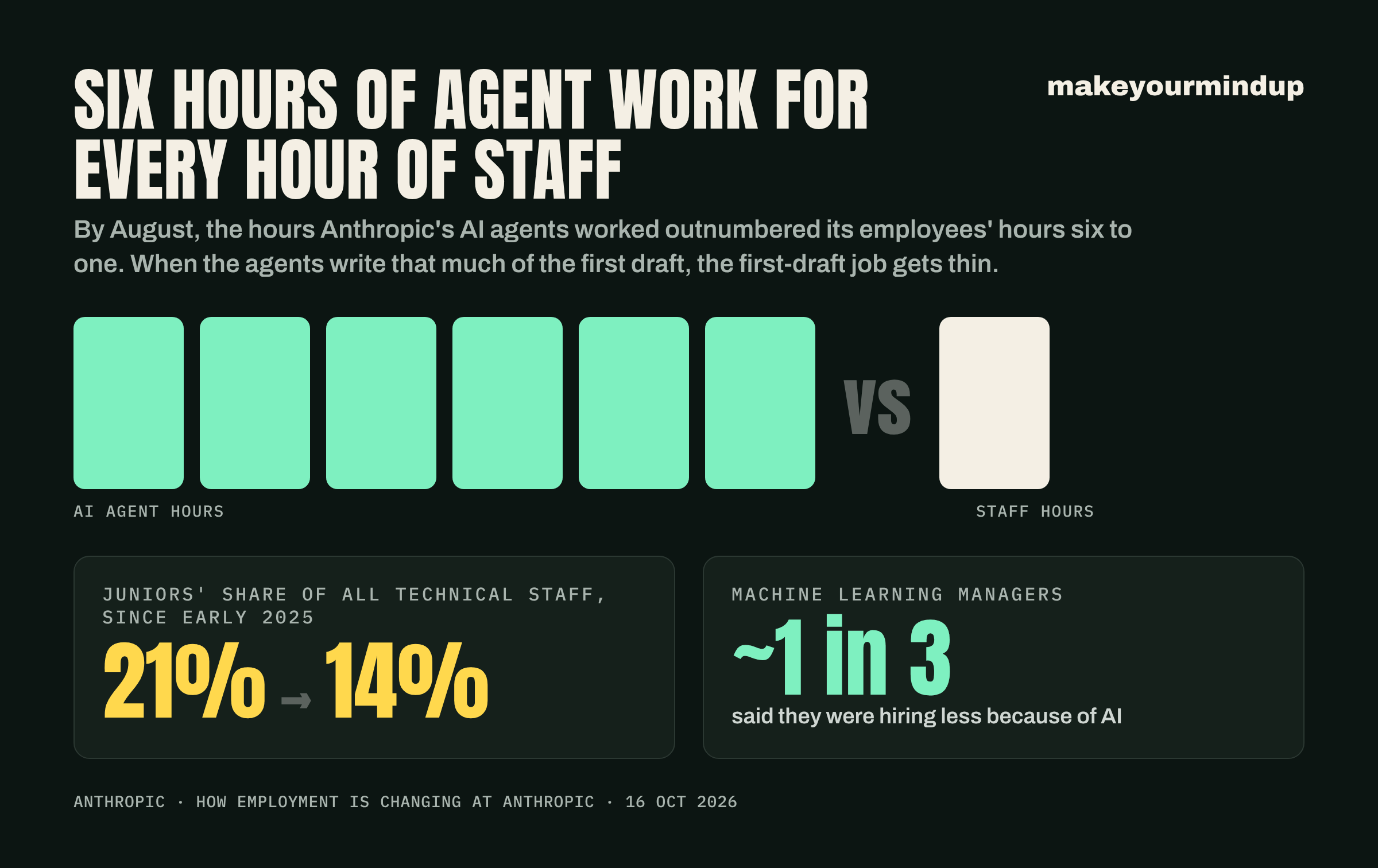
“How Employment is Changing at Anthropic” came out on 16 October, and it’s unusually frank (it’s not every day a company publishes the bit that makes it look awkward). Juniors’ share of everyone on its technical teams, new hires or not, slipped from 21% to 14% over the same stretch. Postings for junior roles “have fallen particularly sharply since December 2025”. By April, its engineering and research teams had cut back on hiring for junior technical roles, and around a third of its machine learning managers said they were hiring less because of AI.
The same report points to a reason. By August, the hours its AI agents (software that carries out tasks on its own) worked outnumbered its employees’ hours six to one. When the agents write that much of the first draft, the first-draft job gets thin.
Outside Anthropic, the picture looks much the same. Seyed Hosseini Maasoum and Guy Lichtinger studied US CVs and job postings, and found that from early 2023, junior employment at firms that adopted generative AI “declined sharply relative to non-adopters, while senior employment continued to rise”. The drop came mainly from slower hiring. Fewer juniors were taken on in the first place.
WE’VE BEEN HERE BEFORE
It’s worth remembering that machines have eaten the bottom of a job before. Twice, quite famously.
You’d expect cash machines to have finished off bank tellers. James Bessen looked at what actually happened, in a piece for the IMF. Between 1988 and 2004, the number of tellers an average city branch needed fell from 20 to 13. But banks spent the savings on more branches, 43% more in cities, and the number of teller jobs held up. Tellers spent less time counting cash and more time talking to customers.
Then came spreadsheets. Since 1980, as NPR’s Planet Money put it, “400,000 bookkeeping and accounting clerk jobs have gone away. But 600,000 accounting jobs have been added.” Planet Money’s explanation is simple: accounting got cheaper, and “when something gets cheaper, people buy a lot more of that thing.”
Our read of both: each tool took the dull bottom of a job, the work got cheaper, people wanted more of it, and the job held up or came back bigger.
WHAT’S DIFFERENT THIS TIME
Here’s the bit that worries us. In both of those stories, the people at the bottom still had somewhere to learn. A teller who stopped counting notes spent more time with customers. As clerks’ jobs went, accountants’ jobs grew.
That’s why we don’t think this is just another cash-machine moment, and Anthropic’s own report hints at the reason. It says that in some roles, its staff are “increasingly removed from the object-level work that originally built their skills”. In plain English, the hands-on work that taught people the job is the work AI now does first. We think juniors feel that most, because that work was their whole training.
And the cut is quiet. Nobody gets a dramatic letter. Anthropic’s researchers put it bluntly: “Employment protections for incumbents will not benefit those not hired to begin with.” It hits the people who never get the job, so they never show up in anyone’s numbers.
WHO TRAINS YOUR 2030 SENIORS
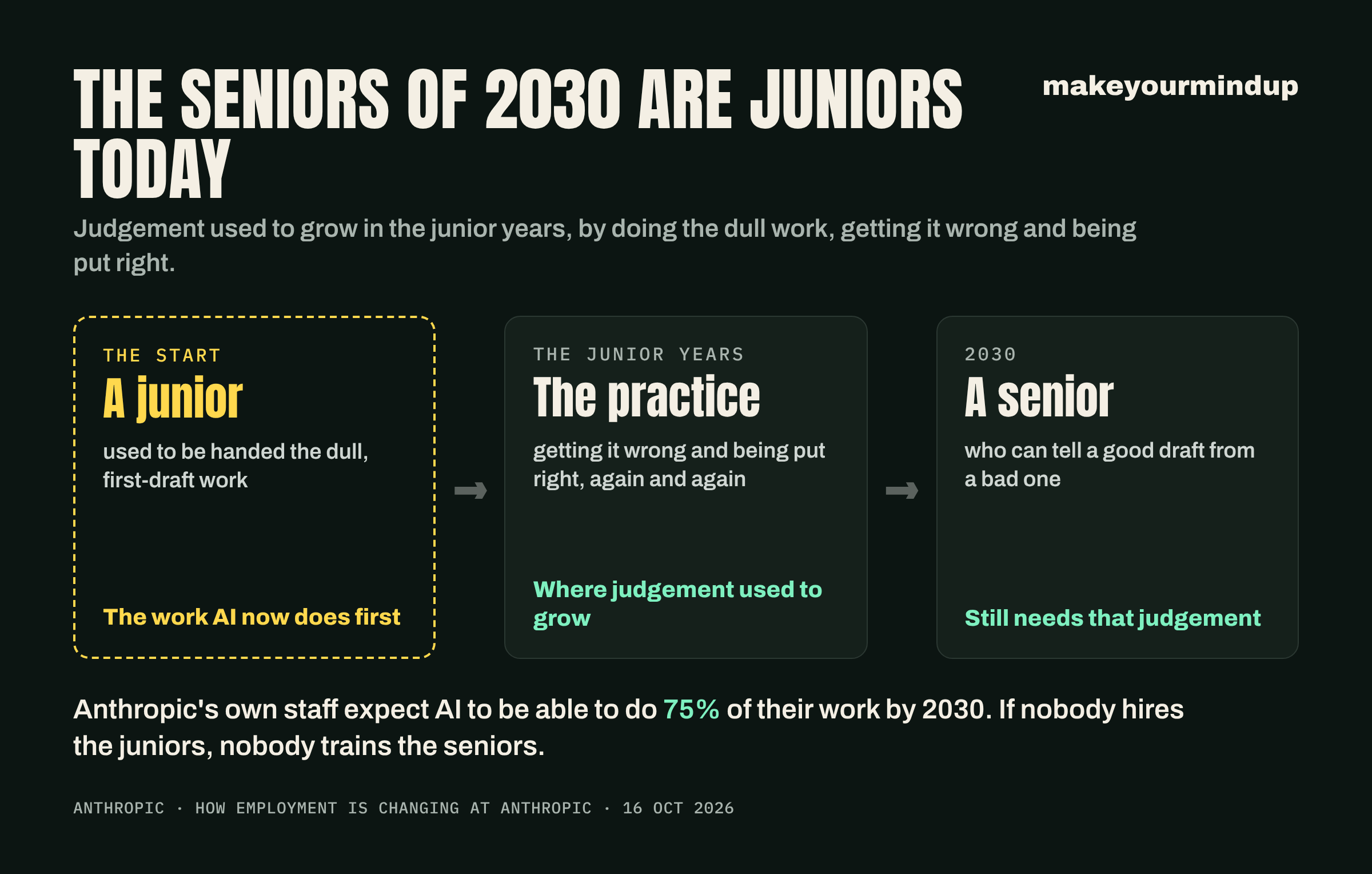
Hiring managers, the same report notes, “increasingly emphasize applicants’ autonomy and judgment relative to specific technical expertise”. That makes sense. If AI writes the first draft, you need people who can tell a good draft from a bad one.
But judgement is exactly what people used to pick up in their junior years, by doing the dull work, getting it wrong and being put right. Take away the junior years and you still need the judgement. You just have nowhere left to grow it.
That’s why this is every business’s problem, and Anthropic’s staff are only early to it. They expect AI to be able to do 75% of their own work by 2030. Whatever the right number is for your business, the seniors you’ll need in 2030 are juniors somewhere today. If nobody hires them, nobody trains them.
WHERE THE LESSON LIVES
Picture a new hire given a dull job: the same task, by hand, for weeks. Somewhere along the way they notice it repeats, and wonder if there’s a better way. So they go looking. The first attempt doesn’t work. Neither does the second. They keep at it, knowing the days they’re spending might be wasted. Then weeks of work shrink to a few hours.
The real lesson is the habit: spotting the job that repeats, asking whether it has to be done this way, and sticking with the fix when it doesn’t work at first. That’s how you use AI well, too. And that habit only forms because someone handed over the dull job.
So, a question to take into your next hiring meeting. Before you cut a junior role, ask who on this team will be a senior in 2030, and what they’re learning on today.
And if you’re early in your career, ask in your next interview what real work you’ll learn on. When you find a boring job that repeats, learn how it works before you hand it to AI, then build the fix.
3 things you can do tomorrow
Name your 2030 seniors. For each team, write down who you expect to be senior in four years’ time, and the real work they’re learning on now.
Look at your last three hiring decisions. If AI was the reason a junior role went unfilled, write down who now does the learning that role used to do.
Give one junior one dull job to own. Pick a task that repeats every week. Have them do it by hand first, then build the fix with AI, so they learn how the work works before the tool does it for them.


