

Google told everyone, in a footnote.
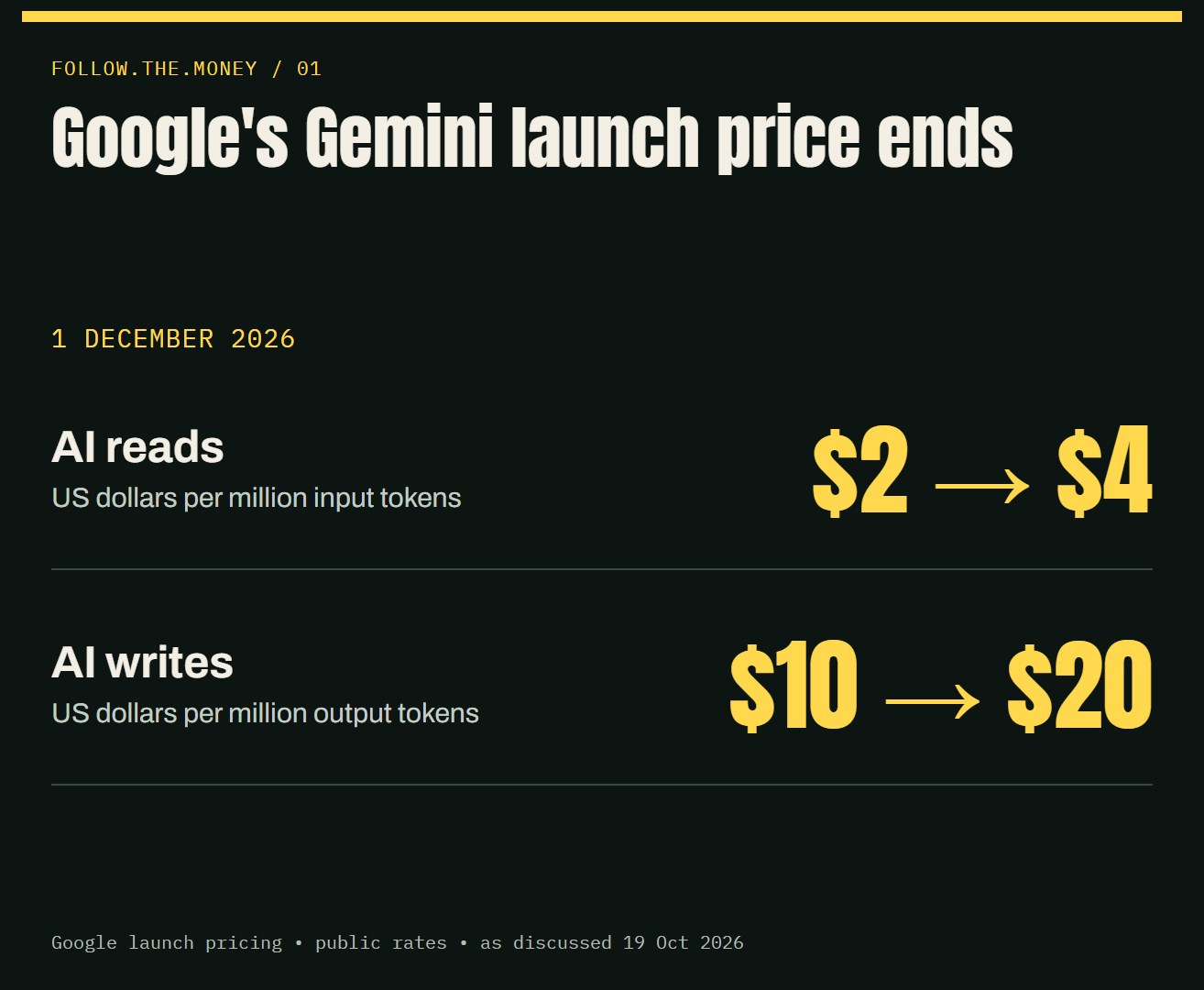
When Google launched its newest AI, Gemini 4 Argon, on 13 October, it called the price “introductory”. Then the footnote: “After the introductory period expires on November 30, 2026, the price of $4 per 1M input tokens and $20 per 1M output tokens will apply.” That’s double.
On its own, that’s a pricing story about one company. But I’ve spent the last week reading the price pages and release notes of the three big AI firms, and it’s part of a pattern. They keep changing their short-term offers, because each one is trying to pull customers off the other two. If you run a company of a few hundred people, the price you pay for AI next year will move several times before you’ve finished budgeting for it.
So what’s durable thinking for a business owner, when every price has a shelf life?
WHAT CHANGES ON 1 DECEMBER
Google charges by the token, which it says is about four characters. You pay for the tokens you send in and the tokens the AI sends back, and Google counts the AI’s “thinking” as tokens sent back.
Here’s Google’s own price list for Argon, per million tokens:
- Tokens in: $2.00 now, $4.00 from 1 December. - Tokens in that it has already read: $0.10 now, $0.20 from 1 December. - Tokens out, thinking included: $10.00 now, $20.00 from 1 December.
Every line doubles. Google’s launch post says this “applies to the Argon model intended for public access only”. If your company pays the public rate, this is your price. If you signed your own deal, your contract decides.
IT ISN’T JUST GOOGLE
Here’s what the other two have done in roughly ten weeks, from their own pages.
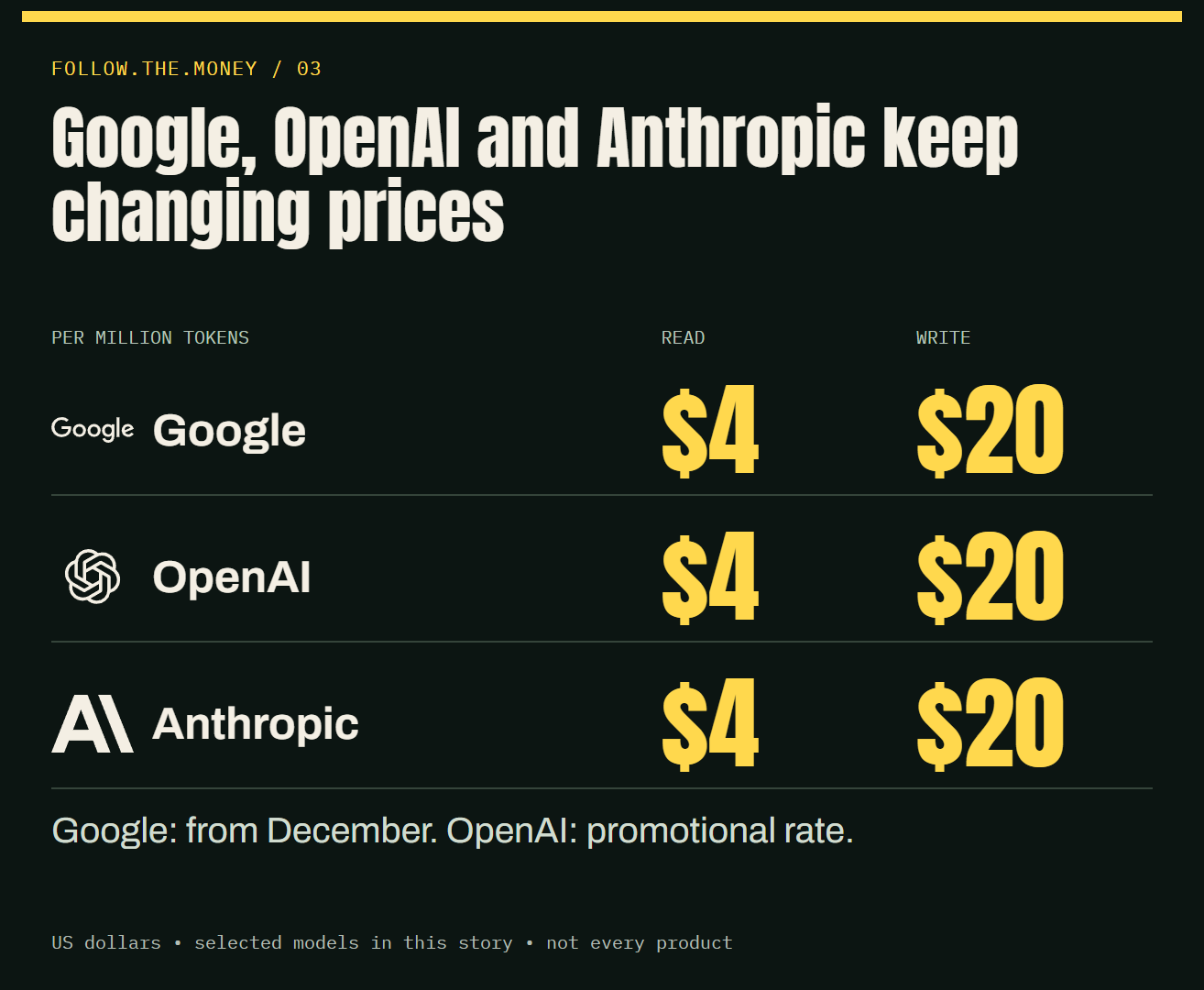
OpenAI, 21 August: “GPT-5.6 Sol now costs $4 per million input tokens and $20 per million output tokens.” Same changelog, same day: “GPT-5.6 Sol’s promotional pricing is available at least through November 21, 2026.” So that’s a cut with an end date on it.
Anthropic, 10 August: “The introductory pricing for Claude Sonnet 5 ($2 / $10 per MTok) is now the standard price: the previously scheduled increase to $3 / $15 per MTok on September 1, 2026 will not occur.” A planned rise, cancelled.
Anthropic again, 22 September: Claude Opus 5.5 launched “at $4 / $20 USD per MTok (Claude Opus 5 is $5 / $25)”. And on 7 October it cut the price of reused tokens on Claude Sonnet 5.5 from $0.20 to $0.10 per million.
Count them with Google’s and that’s at least six moves in about ten weeks. And none of this covers what big customers pay. Enterprise deals are negotiated in private, so the public price lists are the only fair comparison. And honestly, I find the pattern more telling than any single price.
WHY THEY KEEP DOING IT
My personal take : these firms are in a fight for the same customers, and price is the fastest weapon they have. A low launch price gets your team building on one AI. Once your instructions, your tools and your staff habits are set up around it, moving costs time and money. That’s when the full price arrives.
Look where the top models have landed. From 1 December, Argon is $4 in and $20 out. GPT-5.6 Sol is $4 and $20, on a promotion. Claude Opus 5.5 is $4 and $20. Three rivals, one price, and every one of those numbers has moved this year. So the durable lesson is simple: treat every AI price as temporary, and plan as if it will change.
EVEN THE DISCOUNTS DON’T LAST
The obvious answer to moving prices is to chase the savings. The catch is that the same firms set the savings, so they move too. Here are the two big ones, and why neither is something to plan on.
The first is reuse. Most business AI repeats itself. Your customer-service assistant sends the same long policy document with every question, and the question is the only part that changes. Google’s AI notices when a request starts the same way as one it saw a moment ago, and its launch post says those tokens are “95% off”. Google calls this context caching. Claude calls it prompt caching. I’ll call it reuse 😊.
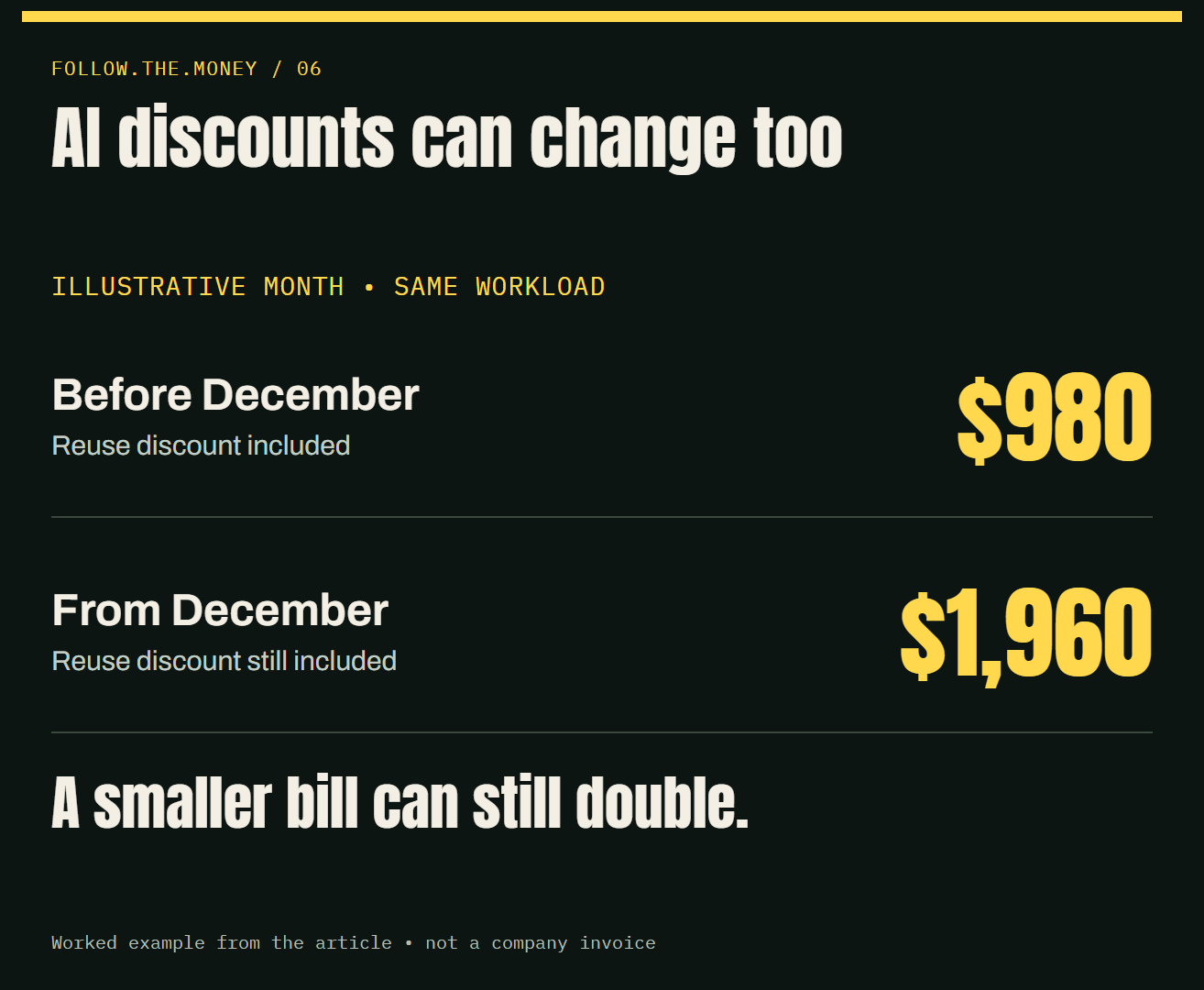
Here’s a made-up month for a customer-service team. Say it sends 100,000 requests. Each one carries 10,000 tokens in, 8,000 of them the same reused policy, and gets 500 tokens back.
- Without reuse: $2,500 a month now. $5,000 from December. - With reuse: $980 a month now. $1,960 from December.
Reuse saves about 60%. The reused price doubles as well, so the bill still doubles. And Anthropic has changed its reuse prices twice since the start of September, so the discount itself moves.
The second is a cheaper model. Sometimes that’s smart. Sanchit Vir Gogia, chief analyst at Greyhound Research, put the catch well in Computerworld: “Cheap per token and cheap per task are different claims, and only the second one reaches the budget.” A cheaper AI that needs three tries, or gets it wrong and needs a person to fix it, can cost you more for the same job. So test it on ten real jobs your team does every week, and count the cost of each finished job, fixes included.
Both savings are worth taking. Neither is something to build next year’s plan on, because the firm that sets the discount can change it. That’s why the rules below matter more than any one saving.
THREE RULES THAT OUTLAST THE NEXT OFFER
Here’s what I’d hold on to, whatever the next price change is.
1. Budget at the full price. Gogia told Computerworld that CIOs should budget at the higher rate from day one, and that “a business case built on the launch rate is a business case built to be rewritten in seven weeks”. If the launch price lasts, enjoy it.
2. Put the price in the contract. Gogia also pointed out that Google Cloud’s standard terms allow fee changes unless a price is expressly agreed. If you want a price to hold, it has to be written down, with the date it holds until.
3. Keep the freedom to switch. Keep your instructions and your test jobs in a form you could run on another AI next month. When the next promotion lands, you want to be able to take it, and when one ends, you want to be able to leave.
Our prediction. By 31 December 2026, Google, OpenAI or Anthropic will list its top model below $4 in and $20 out. Three rivals sitting on one price is exactly when one of them moves to win the switch. How sure we are: 95%.
MONDAY’S THREE QUESTIONS
On Monday, find whoever runs AI where you work, inside the company or at a supplier. I’d start by asking how much of what you send is reused. Then I’d ask whether your contract fixes the price or follows the public price list from 1 December, and whether next year’s budget was built at the full price or the launch price.
Don’t renegotiate yet. Get the three answers first, and you’ll know where you stand before the next offer changes it.
If someone you work with signs off an AI budget, send them this before December does.
SOURCES
- OpenAI Aug 21 2026 promotional pricing with visible date - Computerworld: Gogia on budgeting and contracts, 14 Oct 2026 - Anthropic: Claude Platform release notes (Aug to Oct 2026) - Google: Context caching (Gemini API docs), 13 Oct 2026 - Google: Understand and count tokens (Gemini API docs) - Google: Gemini 4 Argon launch post with its pricing footnote, 13 Oct 2026 - Google Cloud blog: Gemini 4 Argon available on Google Cloud - Anthropic: Claude pricing page, Claude Opus 5.5 row (read 19 Oct 2026) - Google: Gemini Developer API pricing, Gemini 4 Argon rows (updated 16 Oct 2026)