


Ask Suno for a song about your dog’s birthday and its AI writes one, sings it and hands it back. I asked it for one literally to roast a friend last week. More than 100 million people have used it, according to Suno... And now, the record labels say Suno learned to do that by copying their recordings without asking. Not too unfamiliar if you’ve worked in the news media space for a little while.
So they sued them - and then one of them changed sides. Warner Music Group settled and became Suno’s partner. Since 9 September, Warner and two other music companies, BMG and Believe, get a share of Suno’s revenue. Universal and Sony’s first case is still running. On 18 September they sued Suno again, over 60,202 recordings. Eleven days later, a US appeals court ruled against another AI company that had trained on someone else’s work.
Same app, same songs, two opposite bets. So here is the question: when a fan makes a song with AI, who gets paid, and who’s going to be left waiting?
FIRST THINGS FIRST: WHAT ARE WE LOOKING AT?
Quick BS check. The AI behind Suno is called a model. Think of it as the engine under the bonnet. Suno trains it on songs. That is where the money fistfight starts.
Suno’s new engine, v6, launched on 9 September 2026. Suno says it was “developed with our industry partners, including Warner Music Group, BMG and Believe”.
The partners chose which of their music the new engine studied. “Warner has basically figured out which music to hand over as part of that process for training,” Suno’s chief product officer, Jack Brody, told Music Business Worldwide (MBW). He then said that v6 “was trained entirely from scratch” on data that “doesn’t include data from Universal or Sony.”
HOW WE GOT HERE
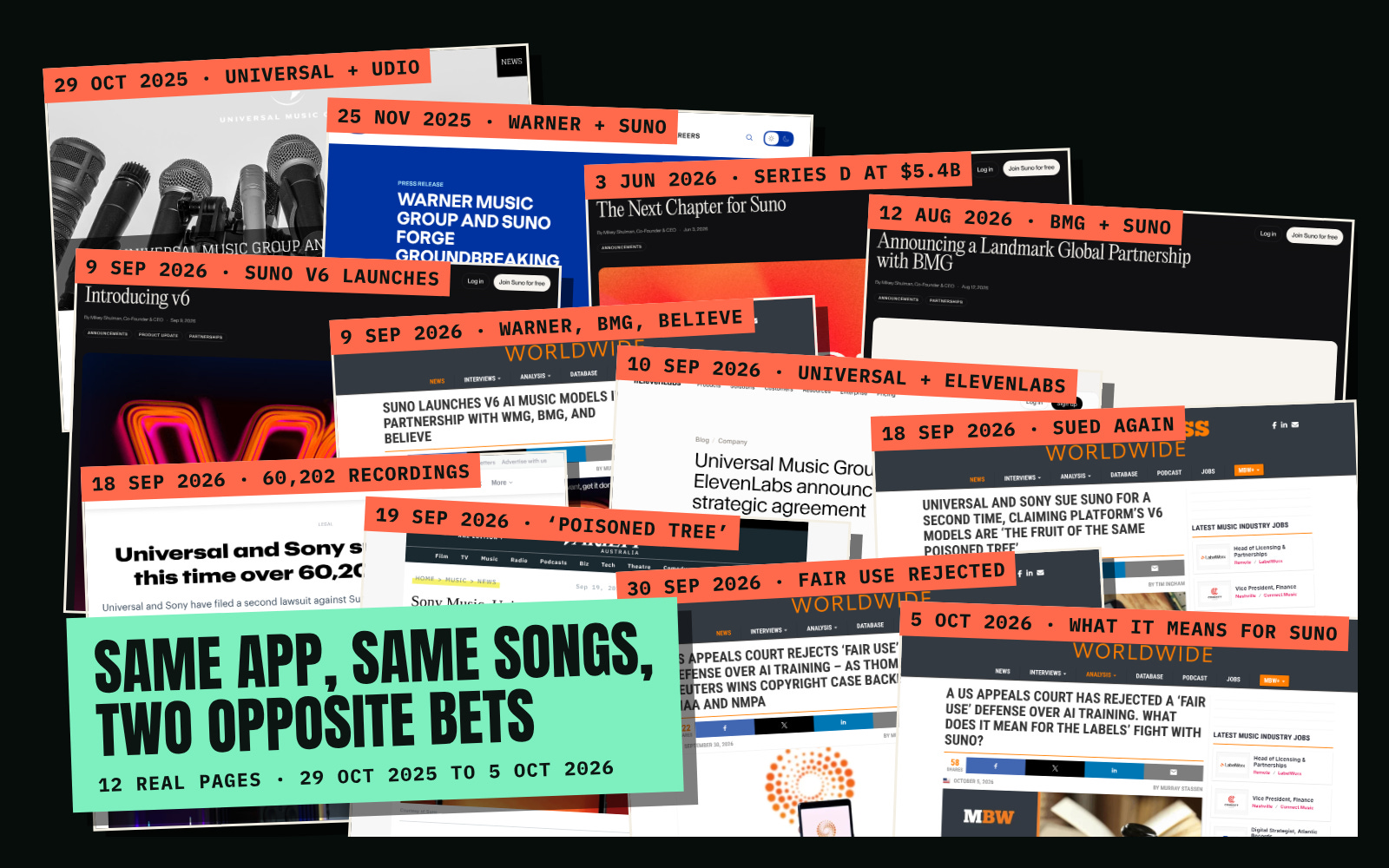
June 2024. Universal and Sony sue Suno in federal court in Massachusetts over 560 recordings. Their new complaint says Suno hid its training data, so they could name only “a minuscule, illustrative fraction” of the recordings it copied.
November 2025. Warner settles its own lawsuit and becomes Suno’s partner. The deal: licensed engines in 2026, with the old ones switched off.
August 2026. Judge F. Dennis Saylor IV refuses to add 61,026 more recordings to the first case, which he wants decided on fair use. The labels, he notes, can sue separately.
September 2026. On the 18th, they do: case 1:26-cv-14275, in Boston federal court. Warner is not among the twelve label companies it names.
THE MONEY MAP
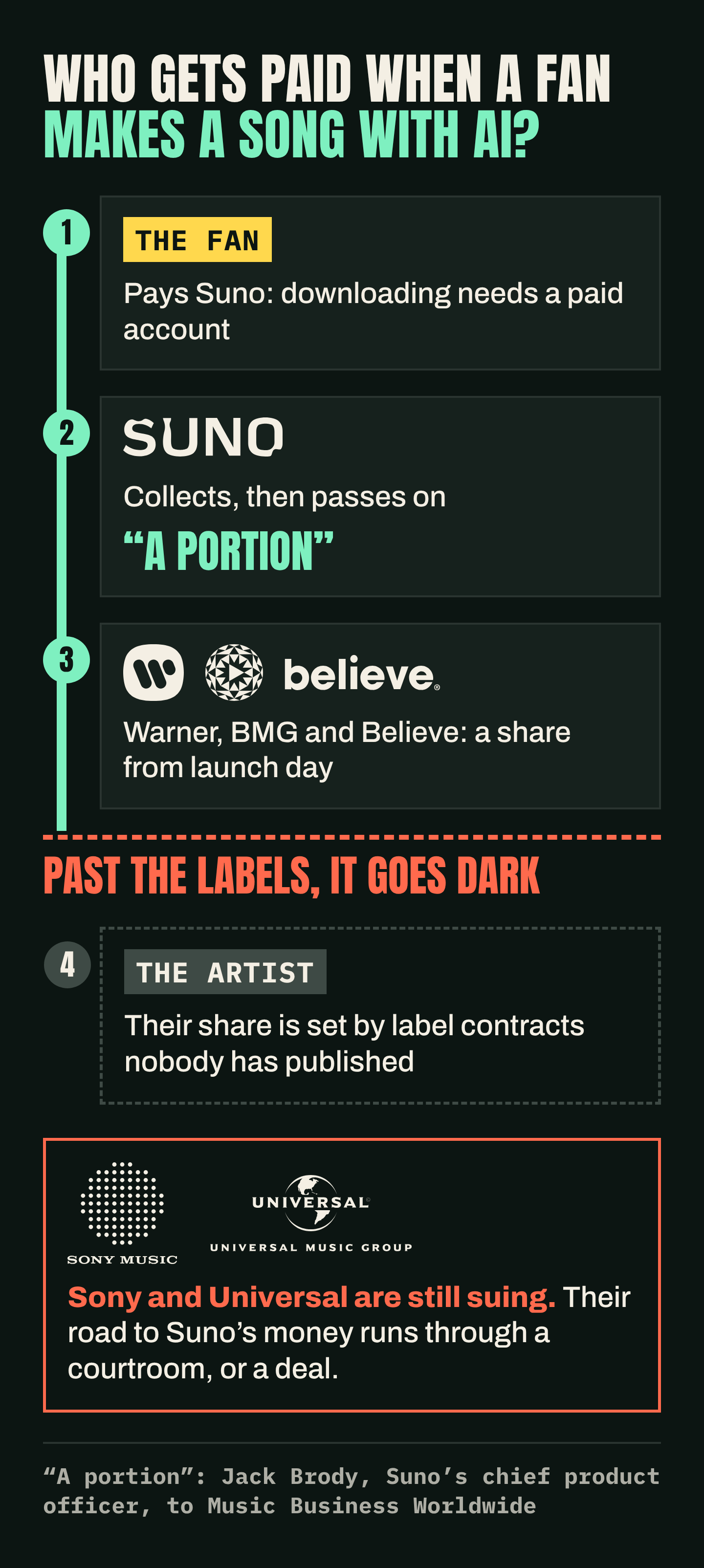
Follow the money from one fan’s song:
The fan pays Suno. Under Warner’s deal, free songs can be played and shared, but downloading needs a paid account, and paid plans have a monthly download cap. Pay, and Brody says “you own the music that you generate on the platform.”
Suno collects. By Suno’s own counts, it had about 2 million paying subscribers and $300 million in annual recurring revenue in February. That second number is the yearly pace of its subscription money. I would treat both as Suno’s claim until it publishes audited accounts. On 1 October its co-founder and chief executive, Mikey Shulman, said Suno is now “far beyond” both. He gave no new figures. A growth claim with no number attached is a mood.
Suno do pass on a portion. From launch day, Brody told MBW, “a portion of our revenue will be shared with our partners, and those rightsholders are responsible for figuring out how to distribute that capital.” Those two words, “a portion”, are doing a lot of heavy lifting.
The labels tend to decide what the artists get. Suno pays the label. My read: the label then pays the artist, under the artist’s own contract. After Universal’s AI deals in 2025, the law firm Manatt listed the open questions for artists: when the money reaches them, how they could audit it, whether they will be told how often their music is used, and whether it just pays off what they already owe their label.
Songwriters and Believe’s artists get promises. Warner’s deal gives artists and songwriters “full control” over the use of their names, voices and songs in new AI music. Believe’s deal says “artists who consent to participate will be compensated”.
Sony and Universal are actually still suing Suno. Their path towards clipping Suno’s money runs through a courtroom, or a deal.
Investors stand to get paid if Suno grows. A round led by Bond Capital put “over $400 million” into Suno, at a $5.4 billion price for the whole company, counting the new money. Suno says some artists, producers and songwriters invested too. So a few musicians could get paid as owners - which is probably the start of something that could blossom.
Think of a wedding band booked through an agency. The couple pays the venue. The venue pays the agency. What reaches the drummer depends on a contract the couple never sees. Suno is the venue, the label is the agency, and the artist is the drummer.
WHY EACH SIDE MOVED
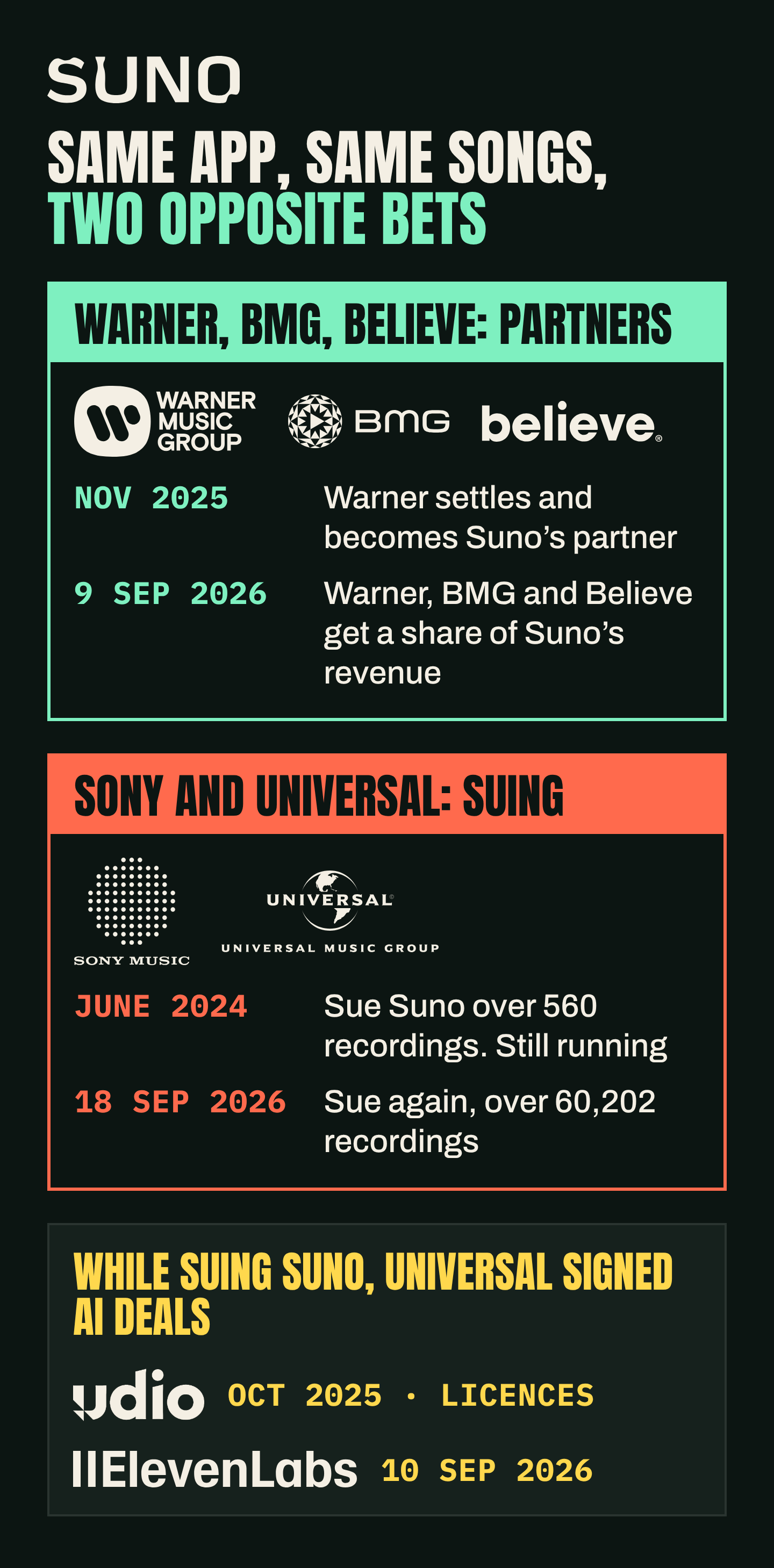
Suno pays because its old engines got it sued. My read: a licence swaps a court risk for a running cost.
Warner signed for the reason its chief executive, Robert Kyncl, gave: “With Suno rapidly scaling, both in users and monetization, we’ve seized this opportunity to shape models that expand revenue.” It gets a revenue share, and it sold Suno a concert-finding site called Songkick.
Universal and Sony keep suing. My read: a lawsuit is also a way to set a price. In October 2025 Universal settled a similar fight with Udio, another AI music maker, and signed licences. On 10 September 2026 it signed with ElevenLabs, an AI audio company, to build a fan music platform “built on licensed music and artist participation”. Universal does sell AI licences, to Udio, while suing Suno.
THE RULING EVERYONE IS READING
On 29 September 2026, the US Court of Appeals for the Third Circuit ruled for Thomson Reuters against ROSS Intelligence, a legal research company. ROSS had used Thomson Reuters’ Westlaw headnotes, short summaries of the points of law in court rulings, to train a rival legal search engine.
ROSS argued fair use, the US rule that lets you copy someone’s work without asking in some cases, the way a film critic can quote a line from a film. The court held that “ROSS’s use was not fair”. It also found that the market for licensing material “to train AI is rapidly developing”, and that a company choosing not to sell licences “does not disprove that a market exists”. MBW tied the ruling to Suno on 5 October.
Two limits, plainly. First, the ROSS ruling does not bind the court hearing the Suno cases. That court is in Massachusetts, which sits under a different appeals court, the First Circuit. A judge there can find the ruling persuasive. He has no duty to follow it. Second, the court drew its own line, in a footnote: ROSS’s AI “cannot generate original expression”. As MBW put it: “ROSS’s platform was not generative, and Suno’s models are.”
And no answer is coming soon. MBW says the fair use question is not expected to reach Judge Saylor until the second half of 2027.
EVERY CHEQUE IS EVIDENCE
In paragraph 97 of their new complaint, Universal and Sony turn Suno’s partner deals against it. Suno, they write, “takes its partners’ recordings as training inputs and pays the rightsholders who supply them”, which they call “a functioning licensing market”.
Suno sees it differently. The complaint quotes Brody saying the revenue share is “not in exchange for training” and that the deals are “not really about the data”.
Why prove a market exists? My read: if paying for training is normal, copying without paying looks like skipping the bill. That is why the ROSS court’s “rapidly developing” market matters to them.
So every payment Suno makes to Warner does two jobs. It makes Suno look legitimate, and it hands Sony and Universal a receipt to wave in court. Picture settling a fence dispute with one neighbour, then watching the other two bring your cheque to court.
WHAT IS REAL, AND WHAT IS THEATRE
Real: the money from Suno to its partners. By Brody’s account it started on launch day. The old engines are gone, and downloads cost money.
Theatre, for now: the artist products. Suno’s launch post calls them “a new kind of product we’re developing”, where artists “can choose to participate and get paid when they do”. The Rundown AI, a tech news site, reports that the fan remix plans leave key terms open: a firm launch date, the price for fans and the formula for paying artists.
Real, and easy to misread: the $9 billion. US copyright law lets a court award between $750 and $30,000 for each work copied, and up to $150,000 a work if the copying was wilful, meaning deliberate. At that top rate, MBW worked out, the 60,202 recordings carry “a theoretical maximum of just over $9 billion”. At the bottom rate, it would be a small fraction of that. The judge picks where to land. And the big number was public. Complete Music Update (CMU), a music business site, put the ceiling for 61,026 tracks above $9.1 billion on 26 May 2026, before Suno was valued at $5.4 billion in June.
WHAT IT MEANS FOR YOU
If you make songs on Suno: on a paid plan, Suno says the song is yours. Once you can remix a real artist, Brody says “some of the ownership rights and some of the nuances around that will differ, because it’s no longer original music creation.” Check who owns the result before you use it in anything you sell.
If you are an artist on a label: your AI money depends on your label contract, so Manatt’s questions are yours to ask. When does it reach me, and does it just pay off what I owe?
WHAT IT MEANS IF YOU BUILD A BUSINESS ON AI
Suno’s story is the price of training data being set in public, in court and in contracts.
A new engine does not wipe the slate clean. The labels’ new complaint says training v6 on the output of Suno’s older engines “launders” the copying, and calls v6 “the fruit of the same poisoned tree”. It is the labels’ allegation, but you would still have to answer it.
A licence can become evidence. Pay one supplier, and the ones you did not pay can point at your cheque.
HOW THE OLD WAY IS CHANGING
My read: the old music deal paid when a fan played a song. The new one also pays when a machine learns from songs, whatever each side calls the payment, and that money lands with the label first.
Creatively, the fan is turning from listener into co-writer. The Universal platform ElevenLabs is building promises fans “remixes and mashups”. So part of an artist’s job becomes saying yes or no to being remixed, and getting paid for the yes. In Suno’s plan, that pay rate is still an open term.
MY CALL
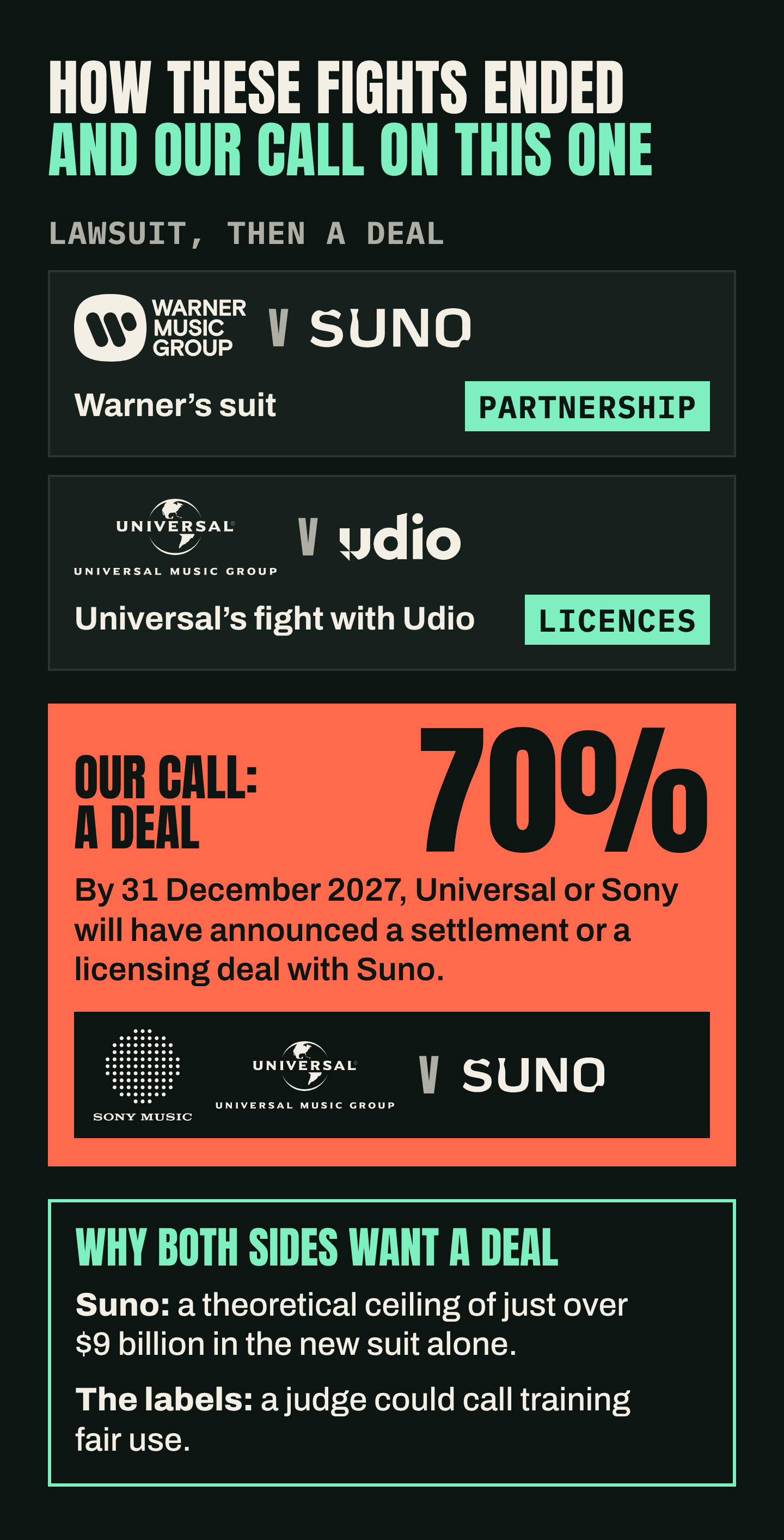
The money is real as far as the labels. Past the labels, it goes dark. In The Rundown’s summary of what Brody told MBW, partners get a share “from launch, with rights holders deciding how to distribute the money”. So the artist’s share is set by label contracts nobody has published. Think of Suno’s deals as a pipe to the labels. What comes out of the label’s tap is the label’s business.
The $5.4 billion price would need one more thing to be true: that the remaining suits end in licences. Warner’s suit ended in a partnership. Universal’s fight with Udio ended in licences. My bet is that Suno’s fight with Universal and Sony ends the same way. Both sides have a reason to want it. Suno faces a theoretical ceiling of just over $9 billion in the new suit alone. My read: the labels carry a risk too: a judge could call training fair use, and a licence nobody needs is hard to sell.
OUR PREDICTION
By 31 December 2027, Universal Music Group or Sony Music Entertainment will have announced a settlement or a licensing deal with Suno.
How sure we are: 70%.