

Before OpenAI shut down its video model, Sora, Higgsfield was Sora’s largest customer by spend and usage, Tech Times reported. OpenAI shut down the Sora 2 models and its Videos API on 24 September 2026. That same month, Higgsfield’s founder, Alex Mashrabov, told a podcast: “we crossed $1 billion in annualized revenue.”
That needs explaining. So let’s take Higgsfield apart.
OpenAI gave its reason for shutting Sora down: “As we focus and compute demand grows, the Sora research team continues to focus on world simulation research to advance robotics.” The Wall Street Journal reported that Sora was costing OpenAI about $1 million a day to run, and that its active users had fallen from around one million to fewer than 500,000. OpenAI gave developers six months to move: it told them on 24 March 2026.
Higgsfield is an AI platform for making video and pictures. You type an idea or upload a photo, pick a camera move or a style, and it makes the clip. It said it had 30 million users in August, the month investors valued it at $5.4 billion.
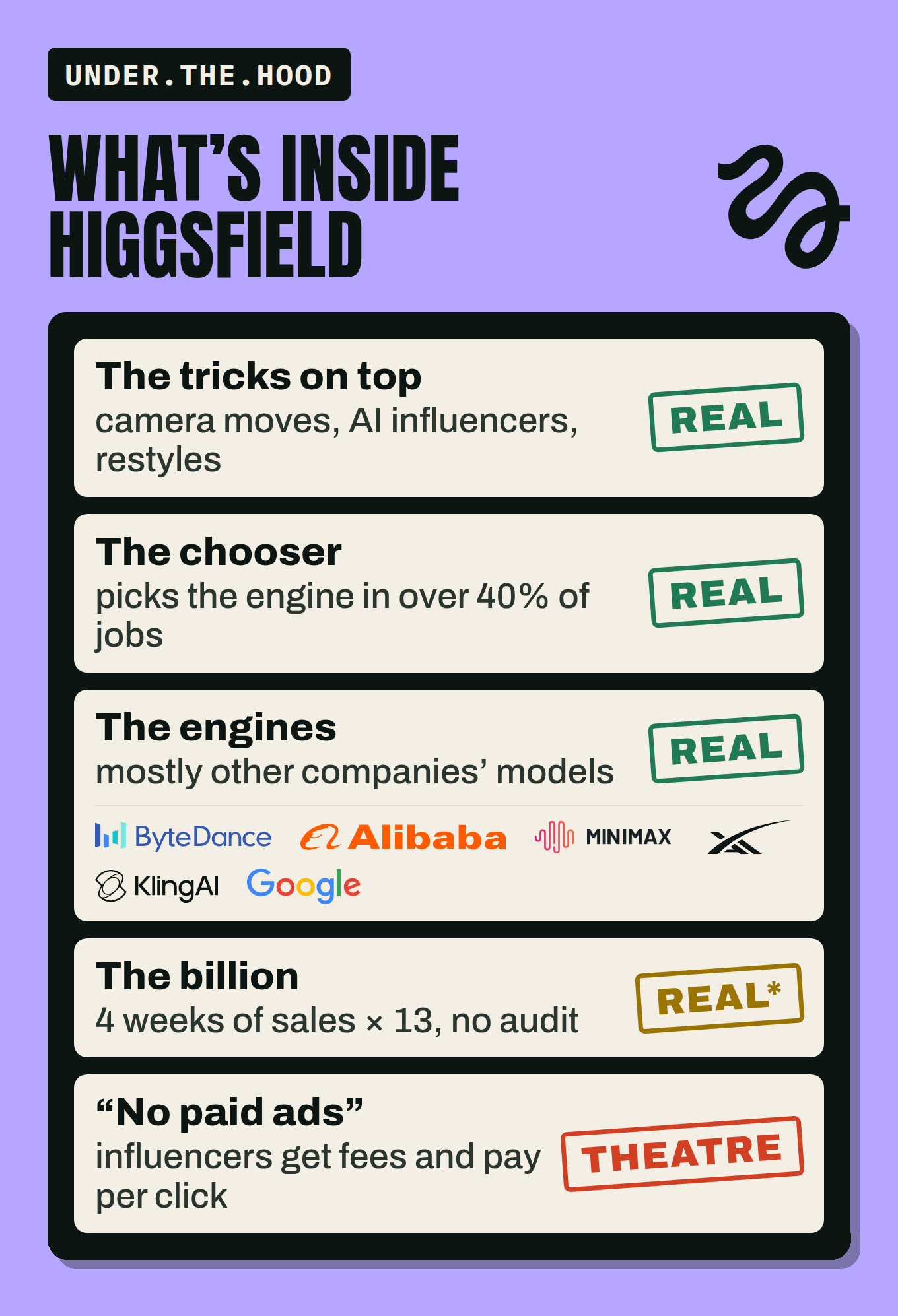
The billion: REAL, with small print. Mashrabov explained the sum on the same podcast: “What we do is look at revenue over the last 4 weeks and multiply it by 13.” Our read: that’s a pace for the year ahead, worked out from four weeks. Still, a billion-a-year pace buys a lot of popcorn.
The engines: REAL, and mostly rented. Higgsfield’s own list of video models for developers reads like a who’s who of other people’s AI. Seedance is ByteDance’s. Wan is Alibaba’s, Hailuo is MiniMax’s and Grok Imagine is xAI’s. Kling and Google’s Veo 3.1 are on the menu too. Higgsfield does build a few models of its own, like DoP, which turns a still photo into a moving shot, and Soul, for fashion-style pictures.
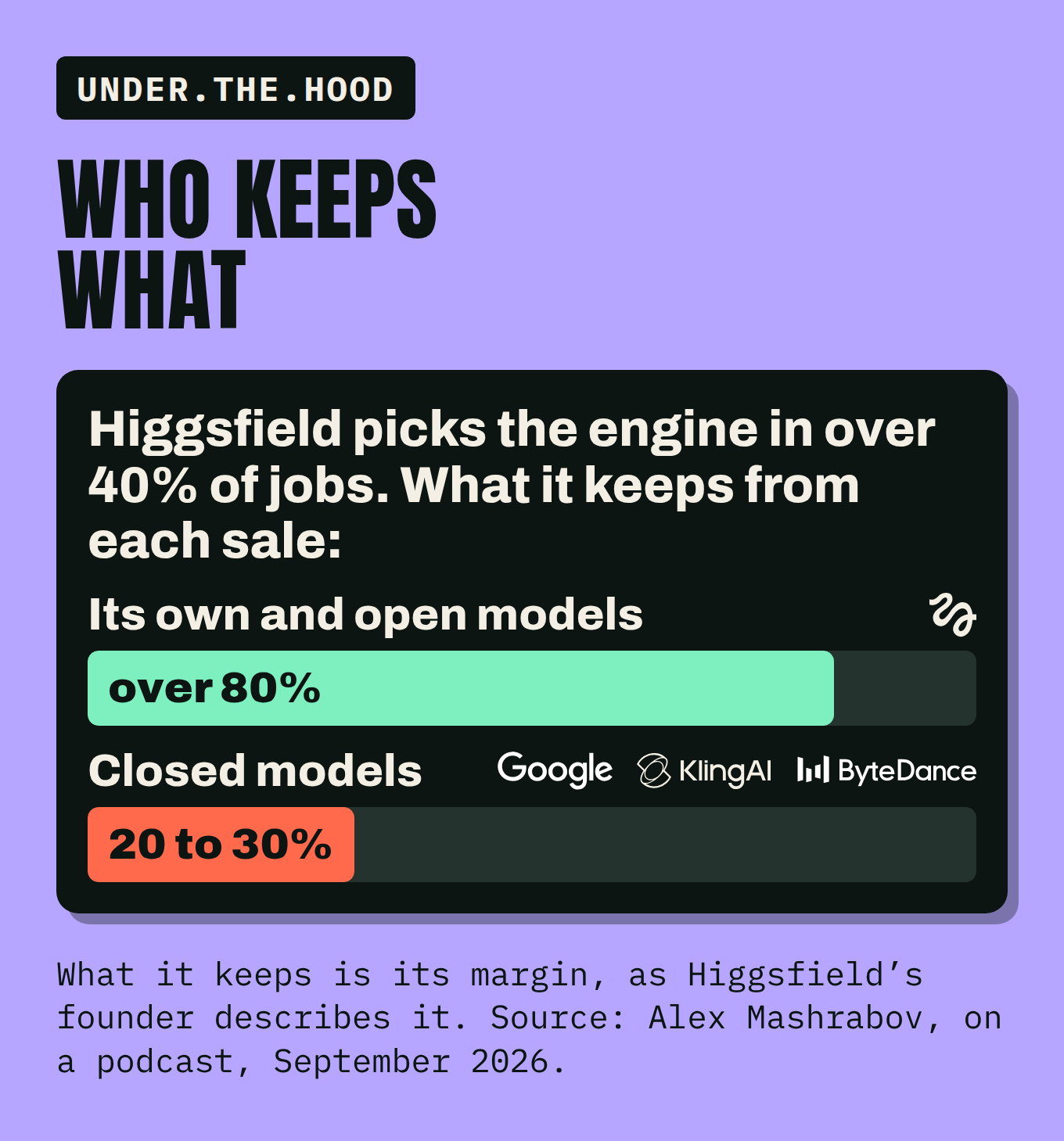
The chooser: REAL, and the clever bit. “We choose what model to use in over 40% of cases,” Mashrabov told the podcast. Think of a travel agent choosing your airline. You still get to Lisbon. They pick the plane that suits them. That matters because of what each engine leaves behind. “The margin on our own models and open-weights models is over 80%,” he said. “For closed-source models, it’s probably between 20% and 30%.”
“We choose what model to use in over 40% of cases”
Alex Mashrabov, Higgsfield’s founder
The tricks on top: REAL, and this is what people pay for. Mashrabov says the team spoke to eight creative directors, and every one of them said camera control was what was missing. There’s also an AI influencer builder. Genjutsu redraws a video in a new style but keeps the original motion, timing and camera work. Ads Studio turns a link to your website into ads.
“No paid advertising”: THEATRE. Asked on the podcast, “You don’t do paid?”, Mashrabov answered: “We don’t do paid.” Then came the follow-up: “Are influencers not paid?” With influencers, he said, “typically there is some fee for video production and then some cost-per-click attribution”. That’s paid marketing in a nicer jacket.
THREE THINGS WE DIDN’T EXPECT
Its own staff spend over $4 million a month on AI. That’s Mashrabov’s figure for close to 400 people, more than $10,000 each. One of them spent over $30,000 in a single week on one model. Even Mashrabov called that “quite a lot”. We agree.
Ninety minutes of film took over 100 hours of footage. For 90 minutes of TV-quality content, Mashrabov says, “there were over 100 hours of AI-generated content”. Our read: AI made footage cheap. Taste is still expensive.
It’s part tech company, part TV studio. Over 150 creative people make its launch videos and tutorials, Mashrabov says, almost half the whole workforce. Well over 70% of its money comes from the West. The largest city by usage is Seoul, he says.
HOW THE OLD WAY IS CHANGING
The creative side. A film used to pass down a long line of people. Mashrabov lists them: “there are scriptwriters, then screenwriters”, then people who break the story down “shot by shot”, then “people who do the storyboarding”, and a director over the lot. His bet: “In 5 years, especially in our space, creative directors are going to be talking to computers and generating stories in real time in video.” The line gets shorter, and the choosing gets harder. In Mashrabov’s own example, 90 minutes of TV-quality content took over 100 hours of AI-generated footage. “Eventually,” he says, “taste is going to matter a lot more than just having stories to tell.”
The money side. Our read: video used to be paid for in days, with a crew, a camera and a set, and now it is paid for by the clip, in rented computing power. So the money follows whoever owns the customer and picks the engine. That’s why the chooser matters so much. Netflix started out mailing DVDs, then began releasing its own shows, starting with House of Cards in 2013. Our read: Higgsfield is running the same play with engines, selling other companies’ first and building a few of its own.
WHAT THIS MEANS FOR YOU
IF YOU WATCH OR MAKE VIDEOS
Anyone can now invent a person. Higgsfield’s AI influencer tool lets you describe one, right down to “age, skin, body and face details”, then make them copy a move from a trending video or a clip you upload. It copies the “movement, camera and timing” frame for frame. It’s free to try, and it works inside ChatGPT. Our read: the next influencer doing this week’s dance in your feed may never have danced at all.
Does it make its users sharper, or more dependent? Both. It hands anyone camera moves that used to need a film crew. But when Higgsfield picks the engine, you may not know whose AI made your video, or whose rules on copyright and faces apply to it. If that matters to you, ask which model made each clip, and keep the answer.
IF YOU’RE STARTING OR BUILDING A BUSINESS
If you just need adverts, you no longer need a film crew to start. Ads Studio turns a link to your website into ads.
If you’re building one of these businesses, our read is that the money can follow whoever owns the job, and the engine maker comes second. Three moves worth copying:
Sell the result. People come to make an advert or a music video. Few of them care which model does it.
Choose for them. A good-enough engine at a good price, picked for the customer, beats a menu with dozens of names on it.
Keep a spare engine. Back in June, Tech Times reported that the Sora API was “scheduled for discontinuation on September 24, 2026“. It closed on the day. If one supplier can switch you off, line up a second before you need it.
And one thing we’d build differently: show customers which engine made each clip, and whose rules apply to it. Higgsfield picks the engine in over 40% of cases. A choice the customer can see is a choice they can trust.
OUR PREDICTION
By 30 June 2027, Higgsfield will raise money at a valuation of $10 billion or more.
How sure we are: 85%.
SOURCES
Every fact in this piece was checked against its source before it went out. Made in public: corrections are welcome in the Substack comments.