

I’ve been having a little play around with Muse, Meta’s new personal assistant, and everyone keeps comparing it with ChatGPT and Claude. I did too, at first. Meta calls Muse “an agent that takes on more of the work so people can focus on what matters to them”. On Apple’s US store it rates 4.9 out of 5.
But the more I used it, the more that comparison felt like apples and oranges. So I wanted to break down what Muse actually is, who it’s for, and what it changes.
THERE ARE NOW THREE KINDS OF AI
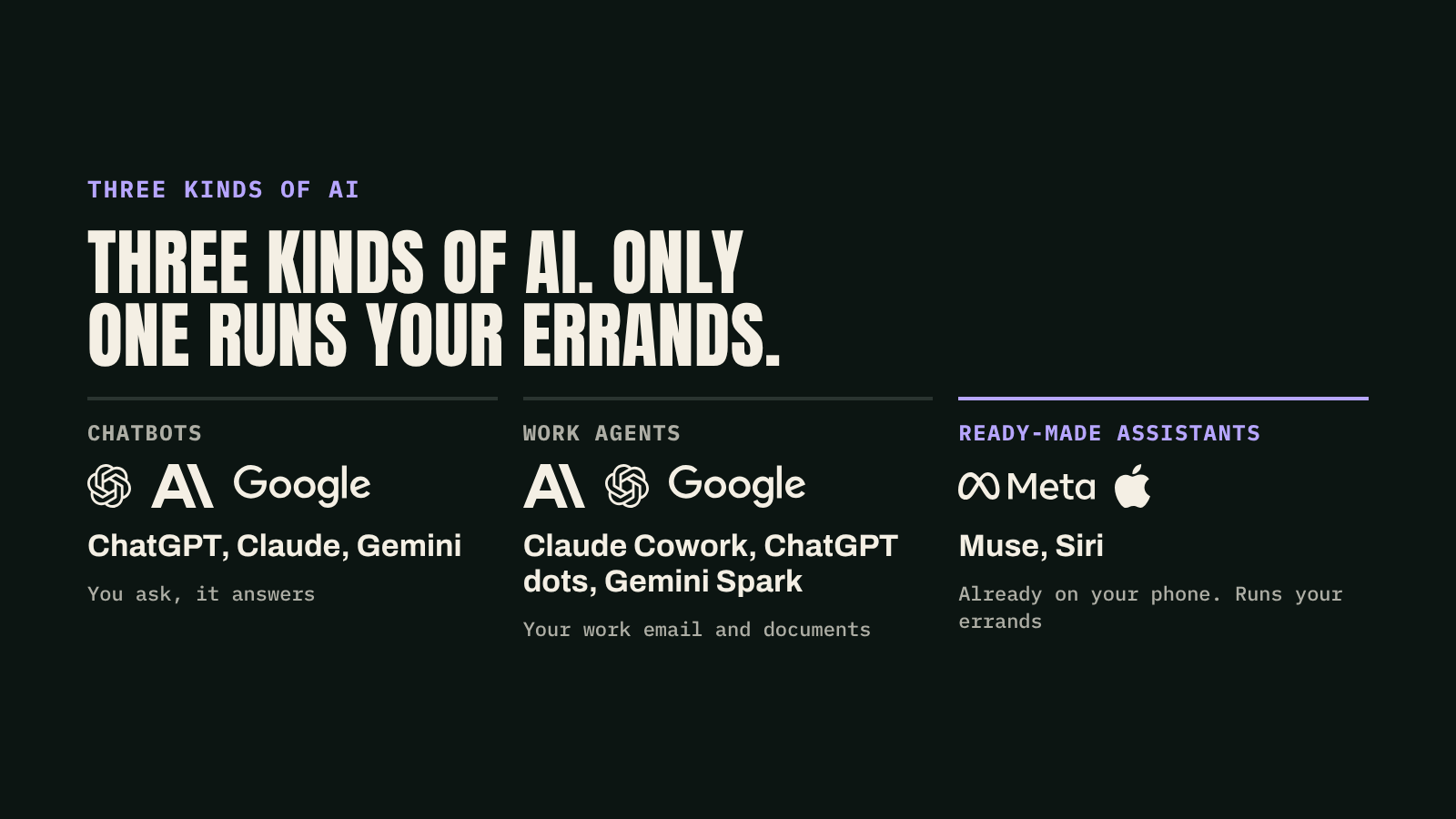
Chatbots. You ask, it answers. That’s ChatGPT, Gemini or Claude in your browser. Most people’s idea of AI is still this one.
Work agents. You hook them up to your email, documents and calendar at work, give them a job, and leave them running. OpenAI’s dots are “always-on agents built to handle everything”. Google’s Gemini Spark keeps working in the background. Anthropic’s Claude Cowork takes a job and keeps working on it in the cloud. They’re built for people at a desk.
Ready-made assistants. The new kid. They come ready inside the phone and apps you already have, and they run your errands. Meta says Muse can “open a browser, fill out forms, and negotiate on their behalf”, and that it “runs on its own dedicated computer in the cloud”. Apple describes Siri AI getting “things done across apps, like drafting an email from scratch, or editing and sharing a set of photos”. They’re built for everyone else, including people who have never opened a chatbot.
So the fair comparison for Muse isn’t ChatGPT. It’s Siri.
EACH COMPANY BUILDS THE KIND THAT MAKES IT MONEY
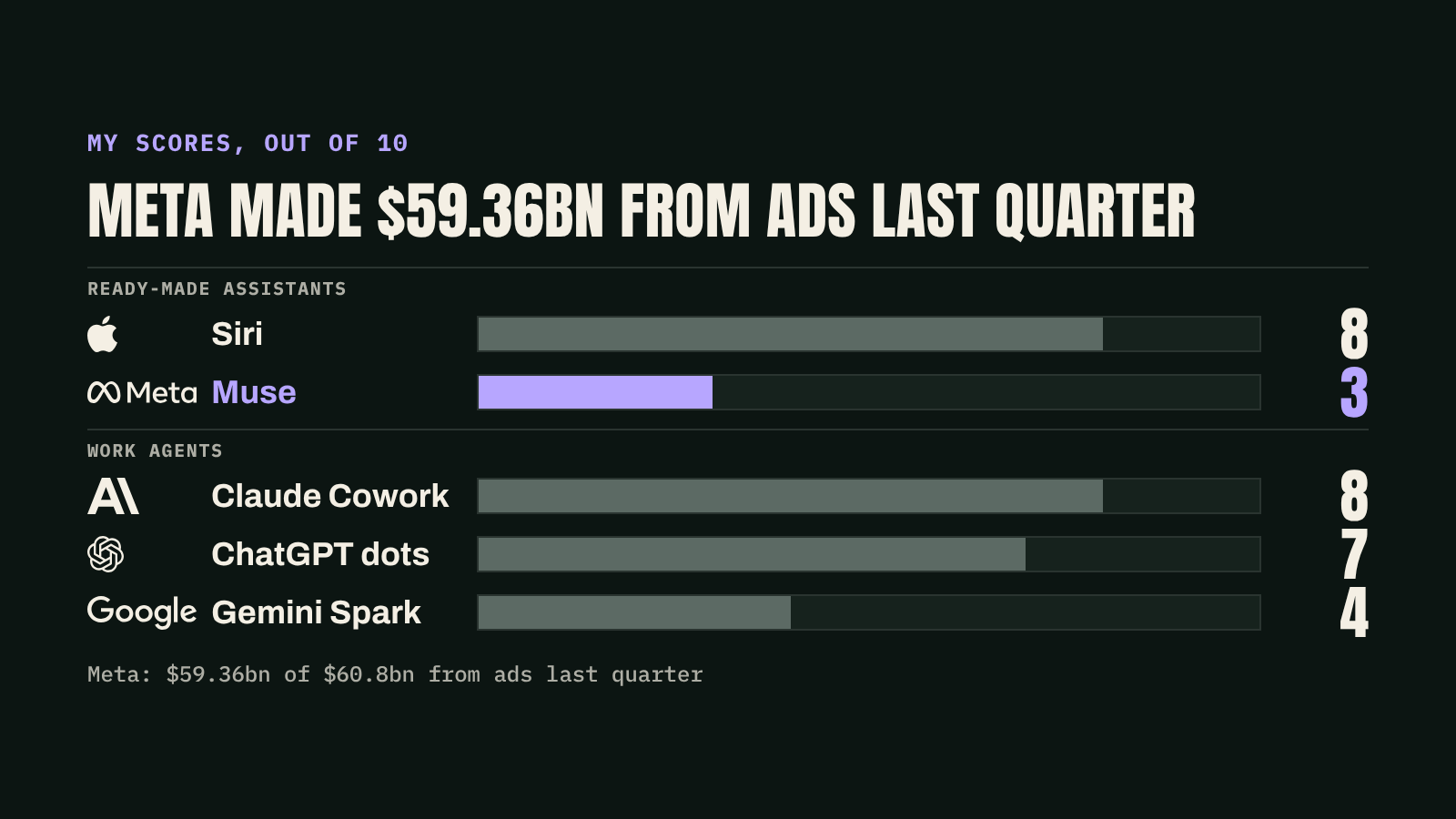
Follow the money and the camps make sense. Meta made $59.36 billion from advertising last quarter, out of $60.8 billion in revenue. Ads pay best when everyone’s there, and Meta also owns Instagram and WhatsApp, apps most of us open without thinking. So Meta builds an assistant for everyone, and makes it “free for most of what people need”.
Apple, as far as I can tell, just wants to sell you the next iPhone. A better Siri is a reason to upgrade.
With OpenAI and Anthropic, you’re the customer, as the prices make clear. Dots come with ChatGPT Pro, from $100 a month. Claude Pro is $20 if you pay monthly. People who pay that every month mostly do it for work, so that’s who the work agents are built for. Google sits in both camps: it makes most of its money from advertising too, but Spark needs a “Google AI Pro or Ultra subscription”, and the cheapest of those is $19.99 a month.
MY SCORECARD
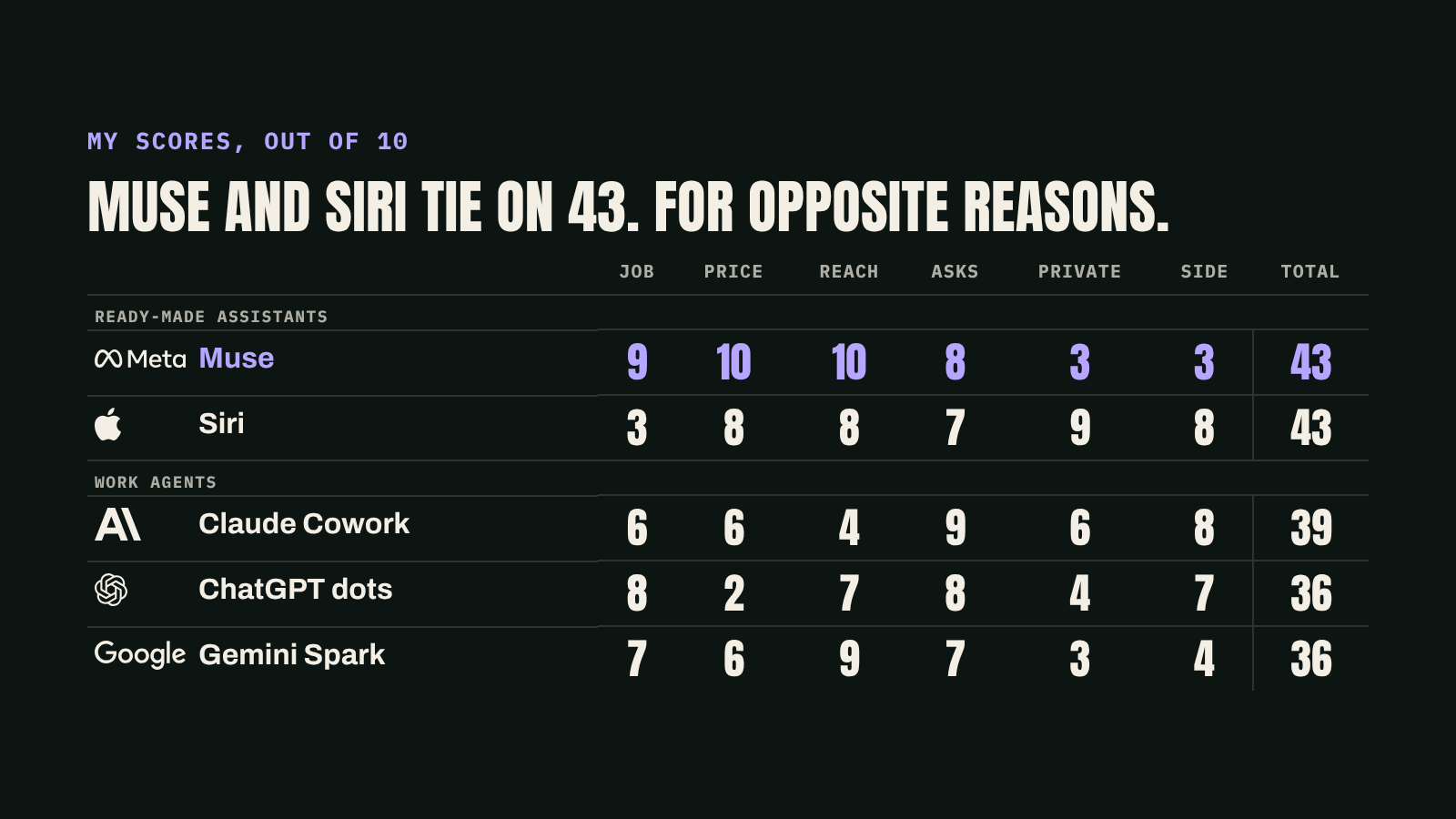
Then I gave all five my own scores on six things: can it do the job, what it costs, whether it’s already in your life, whether it asks before it acts, who can read your stuff, and whose side it’s on. Those numbers are just my opinion; the facts under them are quoted from each company’s own pages. The full grid is in the scorecard picture.
Among the ready-made assistants, Muse and Siri come out level, for completely opposite reasons. The work agents score lower overall, mostly on price and on reach, because they were never built for that market. Claude is the most careful of the lot: “By default, Claude asks before taking an action.”
On my scores, Muse wins on everything you can see: doing the job, price and reach. And it asks first: Muse “checks with the person before sensitive actions like sending an email or making a purchase”, and pays with a one-time card so “your real card details stay hidden”.
Worth saying: the brains are roughly level. CNN’s reviewer found ChatGPT and Gemini “can handle similar tasks and sometimes provided more detailed responses” than Muse, which also suggested two date-night spots that had closed years ago. So the scores are about what each one is allowed to do, not how clever it is.
WHERE MUSE FALLS BEHIND SIRI
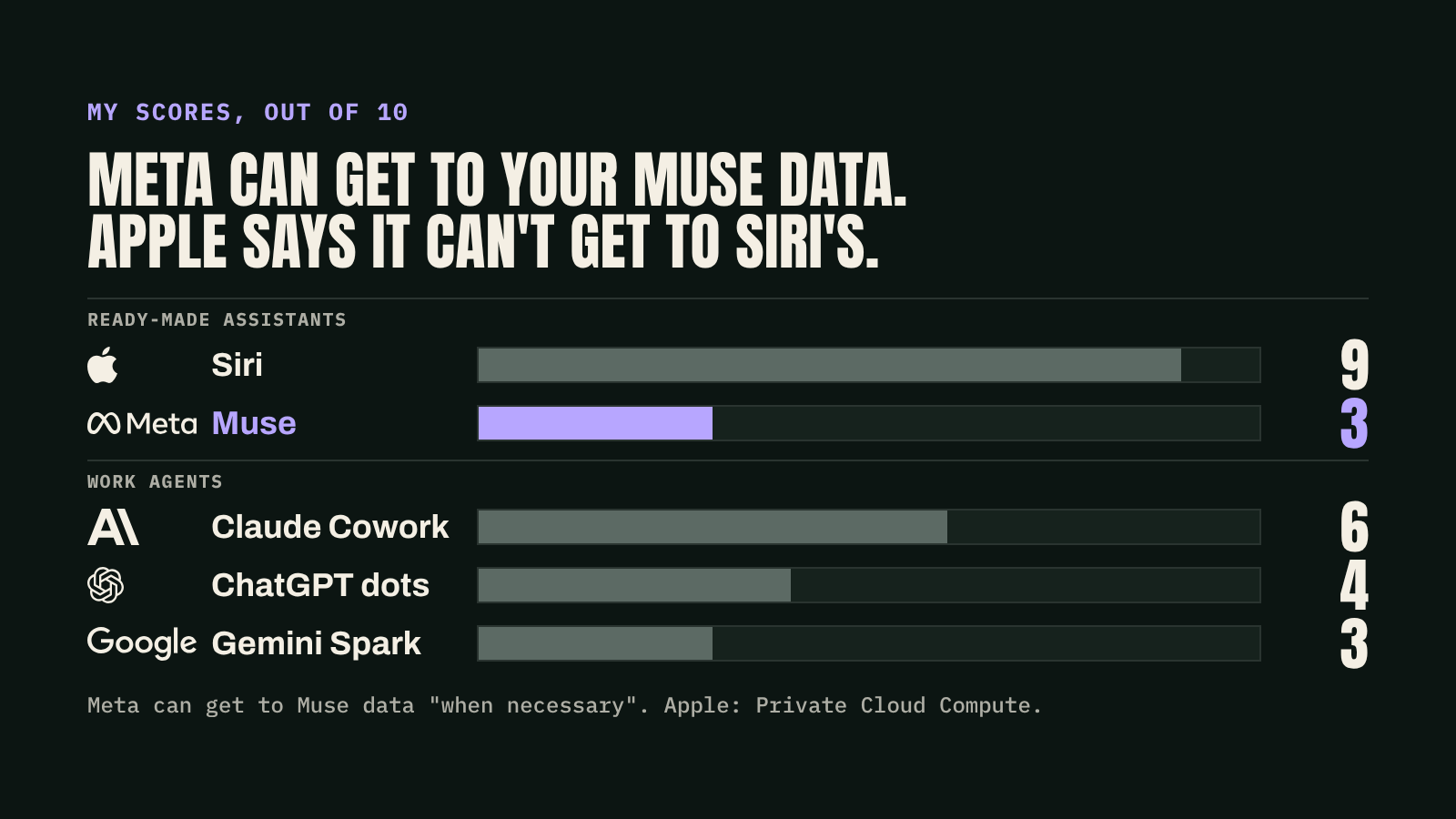
Muse “runs on its own dedicated computer in the cloud”, which Meta says is “where the data and credentials for any service a person connects are securely stored”. That’s Meta’s servers, and Meta’s own safety page says today’s design “does not prevent Meta from accessing data when necessary to support, secure or operate the service”. Meta’s setting to use your Muse chats to train its AI “is on when you first use Muse”. For now, I give Muse a three on privacy.
On privacy, I think Siri AI stands apart. Apple says its models “run on device and on servers using Private Cloud Compute”, where your data is “not stored nor made accessible to Apple or anyone else”. I give it a nine.
EACH SHOP DECIDES
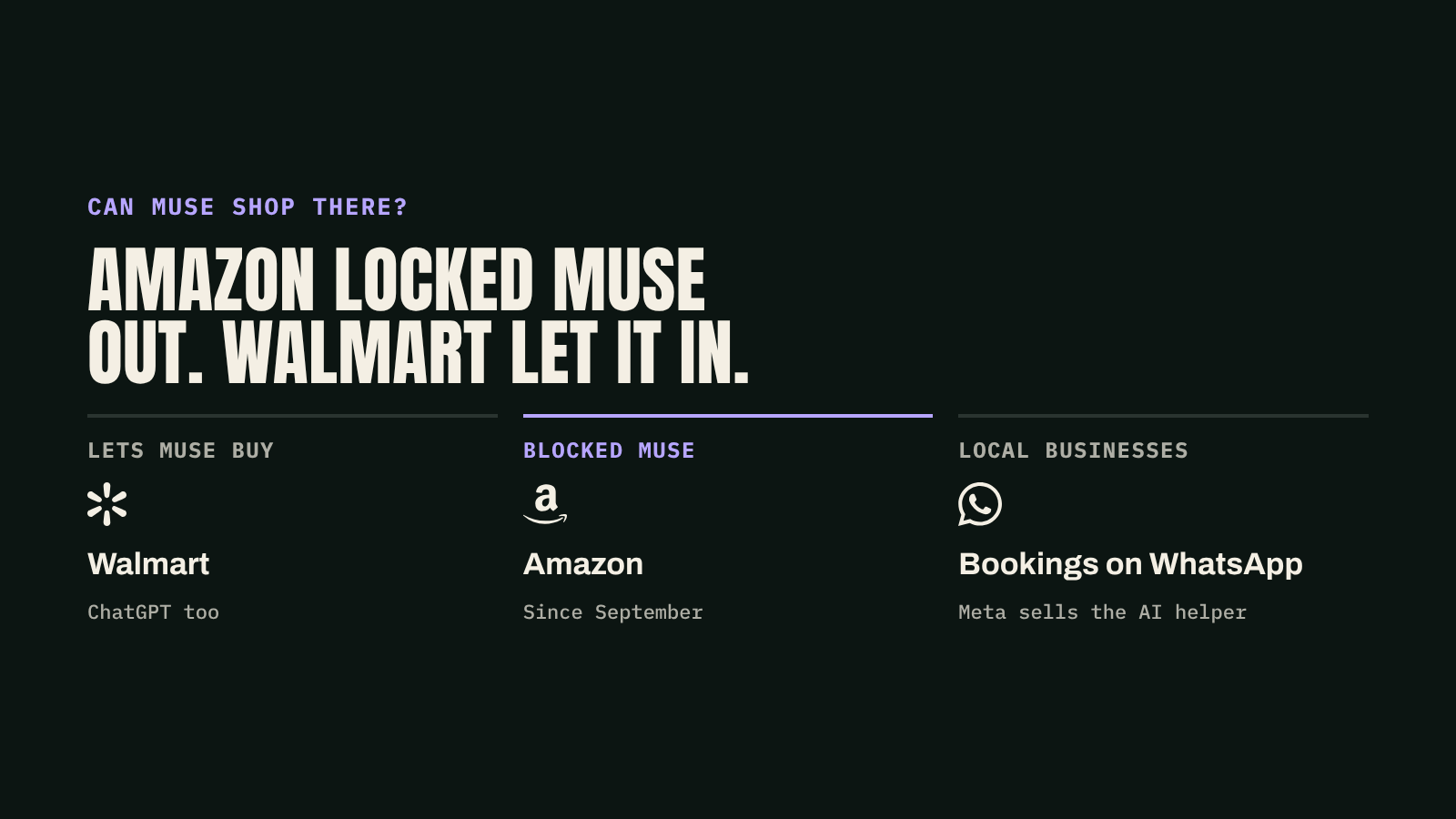
Here’s the bit I think matters most. Muse can shop for you. My read is that each shop now has to decide whether to let it in.
Meta says it’s adding Walmart, Best Buy, Sephora and others to make Muse “an even better shopper”. Walmart signed up with OpenAI in October 2025, so customers could “shop Walmart through ChatGPT”. So Walmart, at least, is plugging into more than one assistant at once.
Amazon blocked it. As of 21 September, people who try to shop on Amazon through Muse get a popup: “Continued access by an unauthorized AI agent violates Amazon’s Conditions of Use, to which our customers have agreed.” My read is that Amazon wants you shopping in Amazon’s own app.
And a local restaurant can’t set up with every AI company. My bet is it goes where its customers already message it: WhatsApp. Meta has an AI helper for businesses there, the Meta Business Agent. In Meta’s words: “More than one million businesses are already using a Meta Business Agent on WhatsApp and Messenger.” And since 1 August, Meta charges for it by the amount it’s used.
My bet is that businesses split the same way the AI does. Big shops plug into every assistant they can. Small ones go where their customers already are, which, for most of us, means Meta’s apps.
SO WHICH ONE SHOULD YOU USE?
If you just want answers, a chatbot is fine. If you live in documents and email at work, a work agent is built for you. If you want errands done from your phone, the ready-made assistants are the new choice: Muse if you want the most done for free (turn the training setting off, and give it small jobs you can undo), Siri if privacy is the deal-breaker.
Whichever you pick, ask it one question now and then: what were the other options?
MY PREDICTION
By the end of 2027, I bet a big airline signs a deal with Meta and Apple so that only Muse and Siri can sell its tickets. Ask ChatGPT for that flight, and it won’t show up. That’s when the assistant you pick starts deciding who you can buy from.
I’ll be wrong if every big airline keeps selling through every assistant, the way Walmart does today. Check back then.